
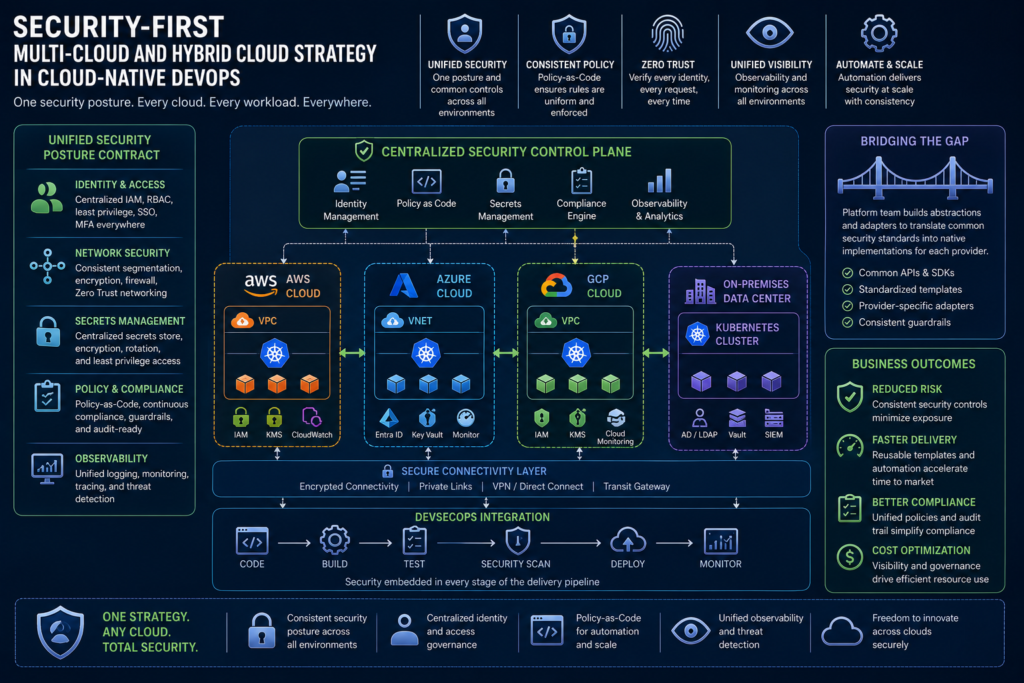
As organizations continue to expand their digital infrastructure, multi-cloud and hybrid cloud environments have become essential for achieving greater flexibility, scalability, and operational resilience. By leveraging multiple cloud providers alongside on-premises infrastructure, businesses can optimize performance, reduce vendor dependency, and support diverse application requirements. However, managing security across these distributed environments presents significant challenges. Differences in security controls, configurations, and governance models can create vulnerabilities that increase organizational risk. A security-first multi-cloud and hybrid cloud strategy helps address these challenges by establishing consistent security standards and centralized governance across all environments.
Modern enterprises often operate workloads across platforms such as AWS, Microsoft Azure, Google Cloud, and private data centers. While each platform offers unique capabilities, inconsistent security practices can lead to fragmented visibility, access control gaps, compliance issues, and operational complexity. A security-first approach focuses on creating a unified security framework that applies regardless of where applications, services, or infrastructure are deployed. This ensures that security remains consistent across all environments while supporting business agility and innovation.
Centralized identity and access management forms the foundation of secure multi-cloud operations. Organizations can implement standardized authentication and authorization mechanisms that apply across cloud providers and on-premises systems. By enforcing role-based access controls, least-privilege principles, and centralized identity governance, businesses can reduce the risk of unauthorized access while simplifying user and service management. Consistent identity controls also improve compliance and enhance visibility into access-related activities throughout the infrastructure.
Policy as Code enables organizations to automate security governance and enforce consistent controls across diverse environments. Security teams can define policies that govern infrastructure configurations, compliance requirements, resource provisioning, and security standards. These policies can then be automatically applied across cloud platforms and Kubernetes environments, reducing manual effort and minimizing configuration errors. Automated policy enforcement ensures that security requirements remain aligned with organizational objectives as infrastructure scales and evolves.
Unified observability and monitoring provide the visibility needed to manage security effectively in complex environments. By consolidating logs, metrics, telemetry, and security events into centralized monitoring platforms, organizations gain a comprehensive view of their infrastructure. This visibility enables security teams to identify threats, investigate incidents, monitor compliance, and respond to security events more efficiently. Consistent monitoring across cloud and on-premises environments also strengthens operational resilience and supports proactive risk management.
Security automation further enhances multi-cloud security by reducing repetitive tasks and improving response times. Automated workflows can detect policy violations, remediate misconfigurations, rotate credentials, and enforce compliance controls without requiring extensive manual intervention. This not only improves operational efficiency but also helps organizations maintain consistent security standards across rapidly changing environments.
🚀 Ready to Transform Your Business?
From AI and Agentic AI to Cloud, Data, Automation, and Digital Transformation, KPSmart IT Solutions helps businesses turn technology opportunities into measurable business outcomes.
Have a challenge? Have an idea? Let’s talk.
👉 Explore KPSmart IT Solutions
KPSmart IT Solutions — Build Smart. Automate. Transform. Grow.
#KPSmartITSolutions #AI #ArtificialIntelligence #AgenticAI #DigitalTransformation #BusinessAutomation #EnterpriseAI #Innovation