
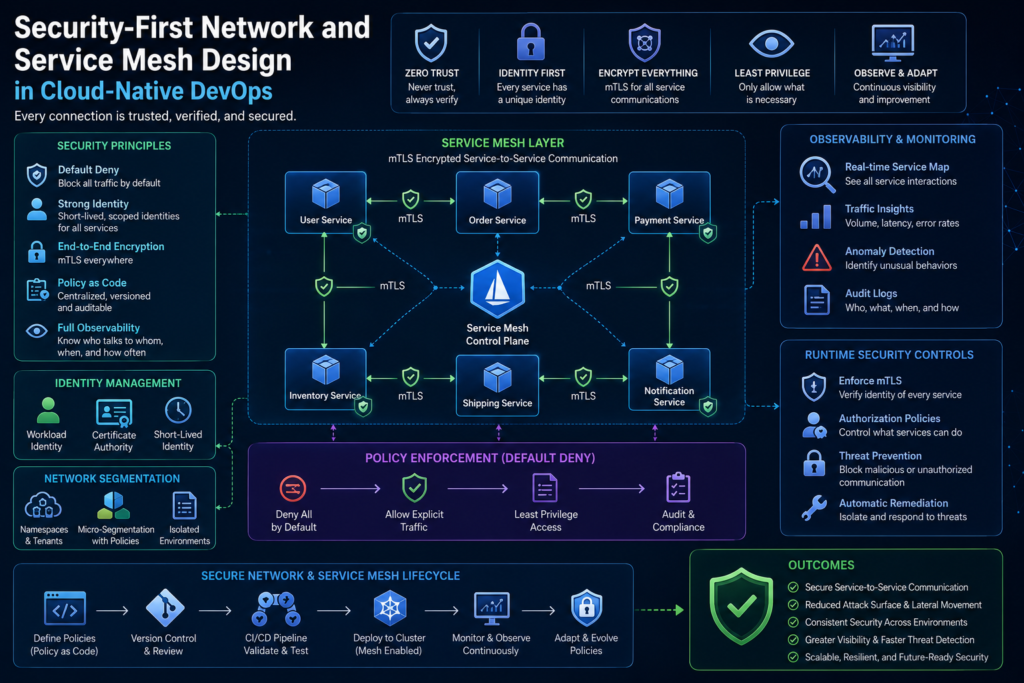
As cloud-native architectures continue to evolve, secure networking has become a fundamental requirement for modern DevOps environments. Many organizations traditionally view networking as a foundational infrastructure layer that requires little attention after clusters, subnets, and connectivity are established. However, modern cloud-native applications consist of numerous interconnected services that constantly communicate across distributed environments. Security-first network and service mesh design addresses these challenges by treating every service-to-service interaction as a potential security boundary that requires authentication, authorization, encryption, and continuous monitoring.
Cloud-native applications are commonly built using microservices that exchange data across containers, clusters, and cloud platforms. Without proper security controls, attackers who compromise a single service may be able to move laterally across the environment and access sensitive resources. Security-first networking minimizes this risk by adopting Zero Trust principles that require verification for every connection, regardless of its location within the network. Instead of relying solely on traditional network perimeters, organizations implement identity-based security models that validate and authorize every service before communication is allowed.
Service mesh technologies play a critical role in enabling secure communication between services. Each service receives a unique identity that can be authenticated, managed, and monitored independently. Mutual Transport Layer Security (mTLS) encrypts traffic between services, protecting sensitive data from interception while ensuring communication integrity. Identity-based access policies further strengthen security by defining exactly which services are permitted to communicate with one another. This least-privilege approach reduces unnecessary connectivity, limits attack surfaces, and improves overall security across cloud-native environments.
Policy enforcement is another essential component of security-first network design. Organizations can implement default-deny communication models that block all service interactions unless explicitly approved. This strategy prevents unauthorized access and significantly reduces the potential impact of compromised workloads. Centralized policy management enables security teams to apply consistent controls across multiple environments without requiring modifications to application code, improving governance and simplifying security operations.
Observability enhances security by providing deep visibility into service communications and network activity. Modern monitoring platforms can collect telemetry data that reveals which services communicate, how frequently they interact, and whether abnormal patterns are occurring. This visibility helps security teams identify suspicious behavior, investigate incidents, detect policy violations, and optimize communication pathways. Real-time monitoring also improves operational resilience by enabling faster responses to potential threats and performance issues.
As organizations continue expanding their cloud-native infrastructure, maintaining secure and scalable communication becomes increasingly important. Security-first network and service mesh design provides a comprehensive framework for protecting service interactions while supporting agility, scalability, and innovation. By combining Zero Trust networking, mTLS encryption, identity-based access controls, policy enforcement, network segmentation, and continuous observability, businesses can strengthen security, reduce operational risks, and build resilient cloud-native environments that remain secure as they grow and evolve.
🚀 Ready to Transform Your Business?
From AI and Agentic AI to Cloud, Data, Automation, and Digital Transformation, KPSmart IT Solutions helps businesses turn technology opportunities into measurable business outcomes.
Have a challenge? Have an idea? Let’s talk.
👉 Explore KPSmart IT Solutions
KPSmart IT Solutions — Build Smart. Automate. Transform. Grow.
#KPSmartITSolutions #AI #ArtificialIntelligence #AgenticAI #DigitalTransformation #BusinessAutomation #EnterpriseAI #Innovation