
Security-First Identity and Access Management for Cloud-Native DevOps
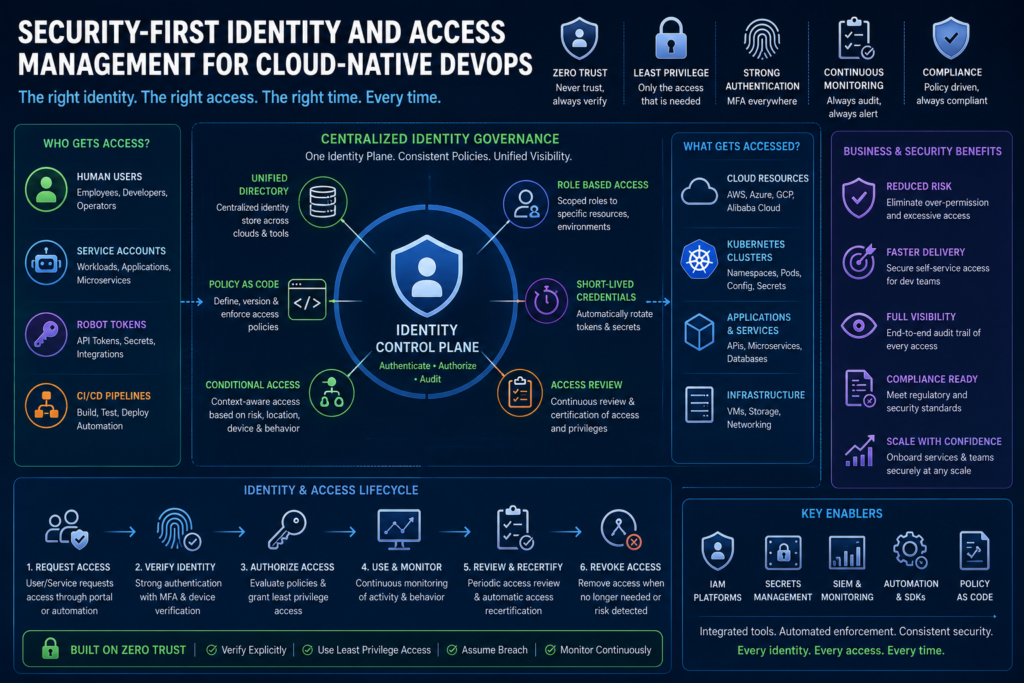
Identity and access management has become one of the most critical security foundations in modern cloud-native DevOps environments. As organizations expand across multiple cloud platforms, Kubernetes clusters, applications, and CI/CD systems, managing identities consistently becomes increasingly complex. Without proper governance, identity sprawl, excessive permissions, and inconsistent access controls can create significant security risks. A security-first approach to identity and access management ensures that every human user, service account, application, automation tool, and deployment pipeline receives only the permissions necessary to perform its intended function.
Modern cloud-native infrastructures contain thousands of identities interacting across services, applications, and cloud resources. Effective identity governance begins with standardized authentication, authorization, and auditing processes that provide visibility and accountability across the entire environment. Every identity should have a clearly defined owner, business purpose, and access scope. This level of control helps organizations reduce unauthorized access, improve compliance, and maintain greater oversight of critical resources.
The principle of least privilege is a core element of security-first identity management. Rather than granting broad permissions, organizations should assign access rights based on specific responsibilities and operational requirements. Human users, service accounts, and automated workloads should only be able to access the resources necessary to complete their assigned tasks. Limiting permissions reduces attack surfaces and minimizes the potential impact of compromised accounts or credentials.
Credential security is equally important in cloud-native environments. Long-lived credentials increase the risk of unauthorized access if they are exposed or mismanaged. Organizations can strengthen security by implementing short-lived credentials, automated token rotation, multi-factor authentication, and centralized secrets management solutions. These practices help ensure that access remains temporary, secure, and aligned with organizational security policies.
Policy as Code enables organizations to enforce identity and access controls consistently across multiple cloud environments. Security and IAM teams can define policies that automatically validate permissions, monitor privileged activities, and prevent unauthorized changes. Automated enforcement reduces human error, improves governance, and ensures that security controls remain effective as infrastructure scales and evolves.
Continuous monitoring and auditing provide the visibility needed to detect suspicious activities and maintain compliance. Detailed access logs, privilege reviews, and identity monitoring help security teams identify unusual behavior, investigate incidents, and verify that access controls are functioning as intended. Monitoring privileged accounts, service identities, and automation workflows enables organizations to respond quickly to potential threats and maintain a strong security posture.
As cloud-native adoption continues to accelerate, identity governance becomes increasingly important for maintaining security, compliance, and operational efficiency. Security-first identity and access management transforms access control from a fragmented administrative task into a centralized security strategy. By combining least privilege principles, Zero Trust security, automated credential management, policy-based enforcement, and continuous auditing, organizations can protect critical resources, reduce risk, and support secure innovation at scale.
🚀 Ready to Transform Your Business?
From AI and Agentic AI to Cloud, Data, Automation, and Digital Transformation, KPSmart IT Solutions helps businesses turn technology opportunities into measurable business outcomes.
Have a challenge? Have an idea? Let’s talk.
👉 Explore KPSmart IT Solutions
KPSmart IT Solutions — Build Smart. Automate. Transform. Grow.
#KPSmartITSolutions #AI #ArtificialIntelligence #AgenticAI #DigitalTransformation #BusinessAutomation #EnterpriseAI #Innovation