
Introduction
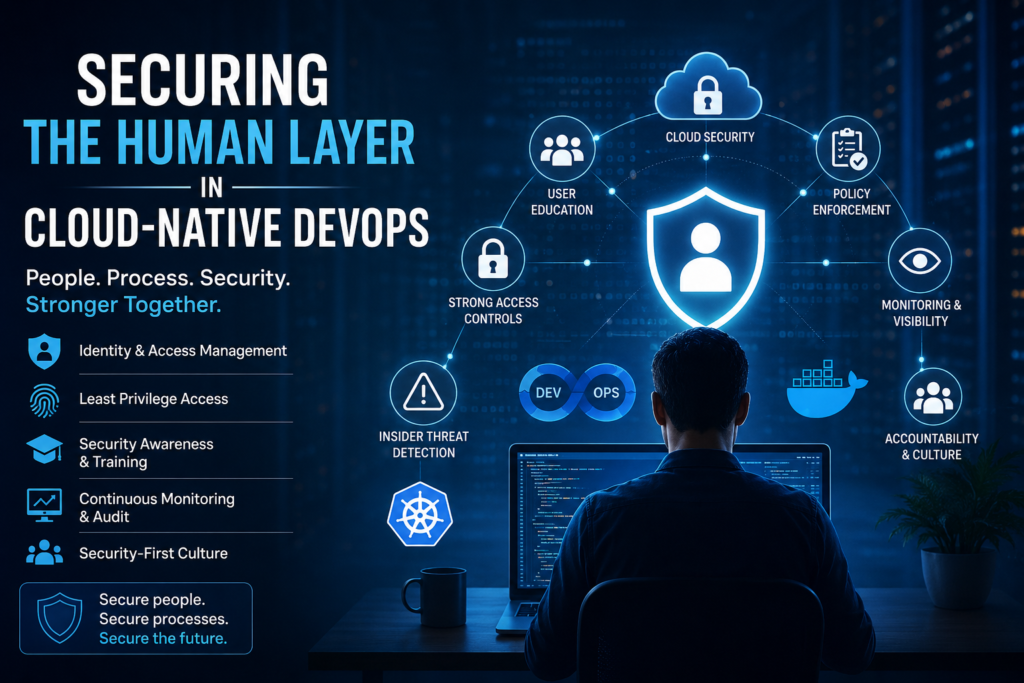
As organizations accelerate their adoption of cloud-native technologies, security challenges continue to evolve. While businesses often focus on protecting infrastructure, containers, Kubernetes clusters, and applications, one critical factor is frequently overlooked: people.
The human element remains one of the largest attack surfaces in modern cloud-native environments. Insider threats, human errors, compromised credentials, and poor security practices continue to contribute to a significant number of cybersecurity incidents worldwide.
Cloud-native DevOps environments are highly dynamic and require constant collaboration among developers, operations teams, security professionals, contractors, and third-party vendors. Without proper controls, even a minor mistake by an authorized user can expose sensitive systems, disrupt operations, and lead to costly security breaches.
To build resilient cloud-native environments, organizations must adopt a human-centric security strategy that addresses both technical vulnerabilities and human-related risks. Organizations can follow security best practices from CISA for secure cloud-native development :
https://www.cisa.gov?utm_source=chatgpt.com
Why Cloud-Native DevOps Security Needs a Human-Centric Approach
What Is the Human Layer in Cloud-Native DevOps?
The human layer refers to every individual who interacts with cloud-native systems, including:
- Developers
- DevOps engineers
- Security teams
- System administrators
- Contractors
- Third-party vendors
- Business stakeholders
These users often have varying levels of access to applications, infrastructure, and sensitive organizational data. A human-centric security approach ensures that individuals use their privileges responsibly while minimizing opportunities for accidental or intentional security breaches.
Why the Human Layer Matters
Many cybersecurity incidents originate from human actions rather than technology failures. Common examples include:
- Weak or reused passwords
- Phishing attacks
- Misconfigured cloud resources
- Excessive access permissions
- Accidental data exposure
- Insider threats
As cloud-native ecosystems become increasingly complex, human-related security risks can lead to financial losses, reputational damage, regulatory penalties, and operational disruptions.
Organizations that prioritize human-focused security practices can significantly reduce their overall attack surface.
Common Human-Centric Security Risks
Insider Threats
Insider threats can be intentional or accidental. Employees, contractors, or partners with privileged access may misuse credentials, leak sensitive information, or unintentionally expose systems through poor security practices.
Credential Compromise
Cybercriminals frequently target user credentials through phishing campaigns, social engineering attacks, and credential-stuffing techniques. Once compromised, these accounts can provide direct access to critical systems and sensitive resources.
Cloud Misconfigurations
Cloud misconfigurations remain one of the most common causes of data breaches. A single incorrectly configured storage bucket, database, or access policy can expose confidential information to the public internet.
Lack of Security Awareness
Employees who lack cybersecurity awareness are more likely to fall victim to phishing attempts, malware infections, and social engineering attacks, making them an easy target for attackers.
Best Practices for Securing the Human Layer in Cloud-Native DevOps
1. Implement a Zero Trust Security Model
Zero Trust follows the principle of “Never Trust, Always Verify.” Every user, device, and application must be continuously authenticated and validated before accessing organizational resources.
Benefits include:
- Reduced insider threats
- Stronger access controls
- Improved visibility into user activities
- Enhanced security posture
2. Strengthen Identity and Access Management (IAM)
Identity and Access Management (IAM) plays a crucial role in protecting cloud-native teams and environments.
Organizations should:
- Implement Role-Based Access Control (RBAC)
- Enforce least-privilege access principles
- Conduct regular permission reviews
- Remove inactive accounts promptly
- Monitor privileged accounts
Proper IAM ensures that users only have access to the resources necessary to perform their job responsibilities.
3. Enable Multi-Factor Authentication (MFA)
Multi-Factor Authentication adds an additional verification layer beyond traditional passwords.
Benefits include:
- Protection against credential theft
- Reduced risk of account compromise
- Improved regulatory compliance
- Enhanced protection for privileged accounts
MFA should be mandatory for all users accessing cloud platforms and critical business systems.
4. Promote Continuous Security Awareness Training
Human error can often be prevented through regular education and training.
Training programs should cover:
- Phishing awareness
- Password security best practices
- Social engineering techniques
- Cloud security fundamentals
- Data protection policies
Well-informed employees become a powerful first line of defense against cyber threats.
5. Monitor User Activity Continuously
Continuous monitoring helps organizations identify suspicious behavior before it escalates into a major security incident.
Key monitoring activities include:
- Login tracking
- Access audits
- Privileged account monitoring
- Behavioral analytics
- Real-time threat detection
Proactive monitoring improves both incident detection and response capabilities.
The Role of DevSecOps in Human-Centric Security
DevSecOps integrates security into every stage of the software development lifecycle, ensuring that security is not treated as an afterthought.
Benefits of DevSecOps include:
- Early vulnerability detection
- Automated compliance validation
- Faster incident response
- Improved collaboration between teams
- Stronger organizational security culture
By embedding security into everyday workflows, organizations encourage accountability and shared responsibility across development, operations, and security teams.
Building a Security-First Culture
Technology alone cannot eliminate human risk. Organizations must foster a culture where security is embedded into daily operations and decision-making.
Leadership Support
Executive leadership should actively champion security initiatives and allocate resources toward cybersecurity programs.
Clear Security Policies
Employees must understand organizational security expectations, responsibilities, and acceptable usage guidelines.
Continuous Learning
Regular training sessions, phishing simulations, workshops, and awareness campaigns help reinforce secure behaviors.
Recognition and Accountability
Acknowledging secure behaviors and holding individuals accountable for security responsibilities encourages long-term cultural change.
Emerging Trends in Human Layer Security
Several trends are shaping the future of human-centric cloud security:
AI-Powered Risk Detection
Artificial intelligence can analyze user behavior patterns and identify potential insider threats faster than traditional security solutions. Organizations are increasingly leveraging research and innovations from OpenAI to improve AI-powered threat detection and user behavior analysis :
https://openai.com?utm_source=chatgpt.com
Adaptive Access Controls
Modern security platforms dynamically adjust access permissions based on user behavior, device health, location, and risk levels.
Security Behavior Analytics
Organizations are increasingly using behavioral analytics tools to understand user activities and detect anomalies before they become incidents.
Continuous Authentication
Rather than verifying users only during login, continuous authentication continuously validates user identity throughout an active session.
Benefits of Securing the Human Layer in Cloud-Native DevOps
Organizations that invest in human-centric security gain several advantages:
- Reduced insider threat risks
- Improved compliance readiness
- Enhanced incident response capabilities
- Stronger data protection
- Increased customer trust
- Lower security-related costs
- Greater business resilience
These benefits directly contribute to long-term organizational success and sustainable growth.
Future Outlook
As cloud-native adoption continues to expand, human-focused security strategies will become increasingly important.
Future cybersecurity programs will combine advanced technologies, continuous monitoring, identity-centric security, and employee education to provide comprehensive protection across cloud-native ecosystems.
Organizations that prioritize human-focused security strategies will be better prepared to handle evolving cyber threats, protect sensitive information, and maintain operational continuity.
Conclusion
Securing the human layer in Cloud-Native DevOps is no longer optional. While organizations continue to invest heavily in cloud security technologies, human behavior remains one of the most significant risk factors in cybersecurity.
By implementing Zero Trust principles, strengthening Identity and Access Management, enabling Multi-Factor Authentication, promoting security awareness, and fostering a security-first culture, businesses can significantly reduce human-related security risks.
Organizations that address both technological and human vulnerabilities will be best positioned to achieve secure growth and resilience in 2026 and beyond.
To learn more about our expertise in cloud-native security and DevSecOps practices, visit our About Us page. For support with implementing secure cloud-native strategies, please visit our Contact Us page.
Link:
About Us →https://morepublicconnect.in/about/
Contact Us → https://morepublicconnect.in/contact/
Frequently Asked Questions (FAQs)
What is the human layer in Cloud-Native DevOps?
The human layer includes everyone who interacts with cloud-native systems, including developers, administrators, security professionals, contractors, and third-party users.
Why is securing the human layer important?
Human errors, insider threats, credential theft, and misconfigurations are among the leading causes of cybersecurity incidents.
What is Zero Trust security?
Zero Trust is a security model that continuously verifies users, devices, and applications before granting access to organizational resources.
How does Multi-Factor Authentication improve security?
MFA adds an additional verification step beyond passwords, significantly reducing the risk of unauthorized access.
What are the biggest human-related security risks in cloud-native environments?
Common risks include phishing attacks, cloud misconfigurations, excessive permissions, insider threats, and compromised credentials.
🚀 Ready to Transform Your Business?
From AI and Agentic AI to Cloud, Data, Automation, and Digital Transformation, KPSmart IT Solutions helps businesses turn technology opportunities into measurable business outcomes.
Have a challenge? Have an idea? Let’s talk.
👉 Explore KPSmart IT Solutions
KPSmart IT Solutions — Build Smart. Automate. Transform. Grow.
#KPSmartITSolutions #AI #ArtificialIntelligence #AgenticAI #DigitalTransformation #BusinessAutomation #EnterpriseAI #Innovation