
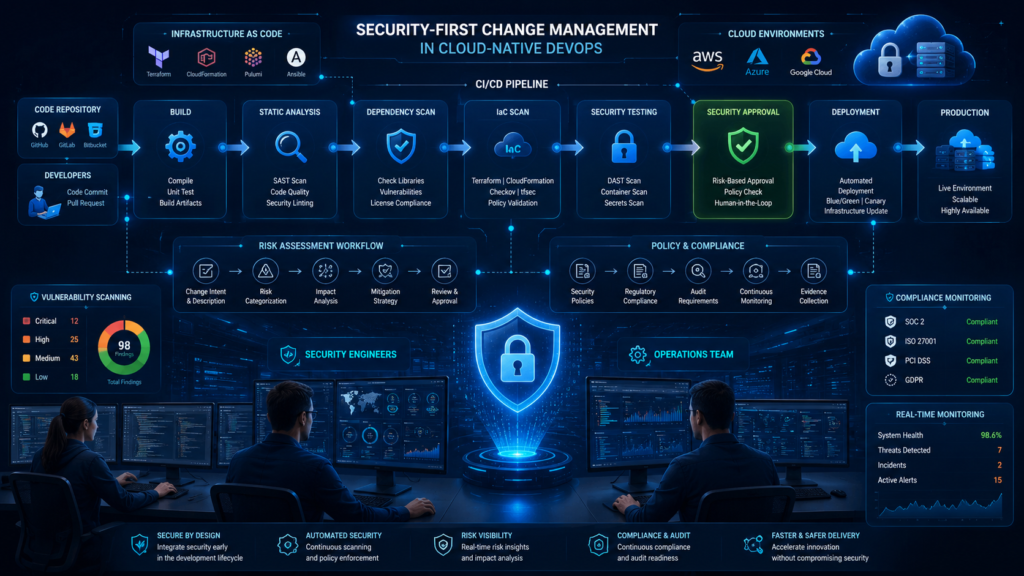
Security-First Change Management is becoming essential for organizations adopting cloud-native DevOps practices. Cloud-native DevOps has transformed the way organizations develop, test, and deploy applications by enabling faster software delivery and continuous innovation. As deployment cycles become shorter and cloud infrastructure becomes increasingly dynamic, managing changes securely has become a critical challenge. Every code update, infrastructure modification, or configuration change has the potential to affect multiple interconnected services. Without proper oversight, these changes can introduce vulnerabilities, compliance issues, operational disruptions, or security risks. secure change management addresses these concerns by ensuring that every change is evaluated not only for functionality and performance but also for its security impact before reaching production environments.
In modern cloud-native ecosystems, organizations must balance speed and security. Development teams are expected to release updates rapidly while maintaining the stability and security of applications and infrastructure. secure change management creates a structured framework that helps organizations assess risks, validate security requirements, and maintain accountability throughout the software development lifecycle. This approach ensures that security considerations are integrated into every stage of the change process rather than being treated as a final checkpoint.
How Security-First Change Management Reduces Risk in Cloud-Native DevOps :
Risk-based assessment plays a significant role in improving change management practices. Low-risk changes, such as documentation updates or minor code adjustments, can move through automated workflows with minimal intervention. Higher-risk modifications involving infrastructure configurations, access controls, third-party integrations, or sensitive data require additional security reviews and approval processes. This allows organizations to maintain agility while ensuring that critical changes receive the attention necessary to prevent security incidents and operational failures.
Automation for Secure Change Workflows :
Automation further strengthens security-focused change management by reducing manual effort and improving consistency. Modern security tools can automatically scan source code, Infrastructure as Code templates, software dependencies, and container images for vulnerabilities before deployment. Continuous integration and continuous deployment pipelines can enforce security policies, validate compliance requirements, and prevent non-compliant changes from progressing through the release process. Automated monitoring and logging provide visibility into every modification, creating detailed records that support security investigations and compliance audits. Organizations can adopt secure software development practices recommended by OpenSSF :
AI-assisted security tools continue to evolve through innovations from OpenAI :
Another important advantage of Security-First Change Management is traceability. Organizations can connect changes to business objectives, compliance requirements, incident reports, and threat-modeling activities. This creates a comprehensive audit trail that improves transparency and enables teams to identify recurring risks and areas for improvement. Security and operations teams can use these insights to strengthen governance, refine security controls, and make more informed decisions about future deployments.
As cloud adoption continues to accelerate, Security-First Change Management enables organizations to support both innovation and resilience. security-focused change management enables development, operations, and security teams to collaborate effectively while reducing the likelihood of vulnerabilities, misconfigurations, and unauthorized changes. By embedding security controls directly into change workflows, businesses can deliver applications faster, improve compliance, protect critical assets, and maintain a strong security posture in increasingly complex cloud-native environments. To learn more about our expertise in cloud-native security and DevOps practices, visit our About Us page. For guidance on implementing secure change management strategies, please visit our Contact Us page.
Link:
- About Us → https://morepublicconnect.in/about/
- Contact Us →https://morepublicconnect.in/contact/
Frequently Asked Questions
What is Security-First Change Management?
security-centric change practices is a structured approach that evaluates the security impact of software, infrastructure, and configuration changes before deployment. It helps organizations reduce risk while maintaining development speed.
Why is Security-First Change Management important in cloud-native DevOps?
Cloud-native environments involve frequent updates, microservices, containers, and dynamic infrastructure. secure deployment workflows helps prevent vulnerabilities, misconfigurations, and compliance issues from reaching production environments.
How does automation support Security-First Change Management?
Automation helps organizations scan code, infrastructure configurations, dependencies, and container images for security issues. Automated workflows improve consistency, reduce manual effort, and prevent risky changes from progressing through deployment pipelines.
What are the benefits of risk-based change management?
Risk-based change management allows low-risk changes to move quickly through automated workflows while ensuring high-risk modifications receive additional security reviews and approvals. This balance improves both agility and security.
How does Security-First Change Management improve compliance?
security-driven change processes creates detailed audit trails, tracks approvals, documents security reviews, and maintains visibility into every change. These capabilities help organizations meet regulatory and compliance requirements more effectively.
+
🚀 Ready to Transform Your Business?
From AI and Agentic AI to Cloud, Data, Automation, and Digital Transformation, KPSmart IT Solutions helps businesses turn technology opportunities into measurable business outcomes.
Have a challenge? Have an idea? Let’s talk.
👉 Explore KPSmart IT Solutions
KPSmart IT Solutions — Build Smart. Automate. Transform. Grow.
#KPSmartITSolutions #AI #ArtificialIntelligence #AgenticAI #DigitalTransformation #BusinessAutomation #EnterpriseAI #Innovation