
Introduction
Cloud-Native DevOps Security has become a critical priority for organizations adopting cloud-native technologies. As cyber threats continue to evolve, businesses must implement Cloud-Native DevOps Security strategies that protect applications, infrastructure, and data across dynamic environments. Organizations can follow security best practices from OWASP for secure cloud-native development :
https://owasp.org
What Is Cloud-Native DevOps Security?
Cloud-native DevOps security refers to integrating security practices throughout the entire software development lifecycle while operating in cloud-native environments. Instead of treating security as a final checkpoint, DevSecOps incorporates security into planning, development, testing, deployment, and monitoring.
This approach enables organizations to:
- Benefits of Cloud-Native DevOps Security
- Detect vulnerabilities earlier
- Reduce security risks
- Improve compliance
- Accelerate secure software delivery
- Enhance operational resilience
Security becomes a shared responsibility across development, operations, and security teams.
Why Future-Proofing Cloud-Native Security Matters
The cybersecurity landscape is evolving rapidly. New attack techniques emerge daily, and organizations face increasing pressure to protect sensitive data while maintaining business continuity.
Several factors make future-proofing cloud-native DevOps security essential:
Increasing Cyber Threats
Attackers are continuously targeting cloud infrastructure, APIs, containers, and software supply chains. Traditional perimeter-based security models are no longer sufficient.
Complex Cloud Environments
Modern applications often run across multiple cloud providers and distributed environments, increasing visibility and management challenges.
Regulatory Compliance
Governments and industries continue introducing stricter security and privacy regulations that require organizations to maintain robust security controls.
Rapid Development Cycles and Secure Software Delivery :
DevOps accelerates software delivery, making automated security controls critical for maintaining protection without slowing innovation.
Major Security Challenges in Cloud-Native DevOps
Container Security Risks
Containers have become the foundation of cloud-native applications. However, insecure container images, outdated dependencies, and misconfigurations can introduce vulnerabilities.
Organizations should:
- Scan container images regularly
- Use trusted repositories
- Apply security patches promptly
- Implement runtime protection
Kubernetes Security Complexity
Kubernetes offers powerful orchestration capabilities but also introduces security challenges.
Common risks include:
- Misconfigured clusters
- Excessive permissions
- Weak access controls
- Insecure network policies
Proper Kubernetes security requires continuous monitoring and configuration management.
API Security Threats
APIs serve as critical communication channels between services. Poorly secured APIs can expose sensitive data and business functionality to attackers.
Best practices include:
- Strong authentication mechanisms
- Rate limiting
- Encryption
- Continuous API monitoring
Software Supply Chain Attacks
Modern applications depend heavily on third-party libraries and open-source components. Compromised dependencies can create serious security vulnerabilities.
Organizations must:
- Monitor dependencies
- Verify software integrity
- Conduct regular vulnerability assessments
- Maintain software inventories
Key Strategies for Future-Proofing Secure DevOps Environments :
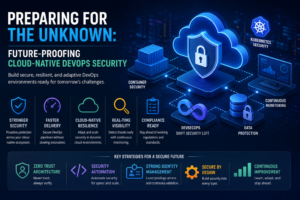
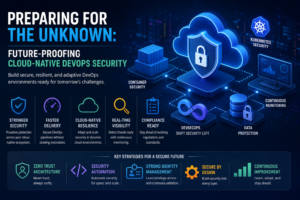
Zero Trust assumes that no user, device, or application should be automatically trusted.
Core principles include:
- Verify every request
- Enforce least-privilege access
- Continuously validate identities
- Monitor user behavior
Zero Trust significantly reduces the attack surface and limits lateral movement within systems.
Shift Security Left
Shift-left security integrates security earlier in the development lifecycle.
Benefits include:
- Faster vulnerability detection
- Lower remediation costs
- Improved code quality
- Reduced security incidents
Automated security testing should become part of every development pipeline.
Automate Security Processes
Manual security processes cannot keep pace with modern DevOps environments.
Automation should include:
- Vulnerability scanning
- Compliance checks
- Configuration validation
- Threat detection
- Incident response workflows
Automation improves efficiency while reducing human error.
Strengthen Identity and Access Management
Identity remains one of the most targeted attack vectors.
Organizations should:
- Implement multi-factor authentication
- Use role-based access control
- Apply least-privilege principles
- Monitor privileged accounts
Strong identity management reduces unauthorized access risks.
Enhance Observability and Monitoring
Security visibility is essential for detecting and responding to threats.
Cloud-native observability should include:
- Log monitoring
- Distributed tracing
- Real-time alerts
- Behavioral analytics
- Security dashboards
Comprehensive monitoring enables faster threat detection and response.
Emerging Security Trends in 2026 :
Several trends are shaping the future of cloud-native DevOps security:
AI-Powered Threat Detection
Artificial intelligence helps identify unusual behavior patterns and detect threats faster than traditional monitoring systems. Organizations are increasingly using guidance and research from OpenAI to improve AI-powered security monitoring and threat detection capabilities :
https://openai.com
Security as Code
Security policies can be defined, version-controlled, and automated similarly to application code.
Continuous Compliance
Automated compliance monitoring ensures organizations remain aligned with evolving regulations and standards.
Cloud-Native Security Platforms
Integrated platforms provide unified visibility across containers, Kubernetes environments, cloud infrastructure, and applications.
Benefits of Future-Proofing Cloud Security :
Organizations that invest in proactive security gain several advantages:
Improved Business Resilience
Strong security controls minimize operational disruptions and reduce downtime.
Faster Incident Response
Automated detection and monitoring help security teams respond quickly to threats.
Better Compliance Management
Continuous compliance reduces regulatory risks and audit challenges.
Increased Customer Trust
Strong security practices build confidence among customers, partners, and stakeholders.
Long-Term Cost Savings
Preventing security incidents is significantly less expensive than recovering from them.
Future Outlook
Cloud-native technologies will continue transforming software development and business operations. As environments become more complex, security strategies must evolve accordingly. Organizations that embrace automation, Zero Trust principles, AI-powered security tools, and continuous monitoring will be better positioned to withstand future cyber threats.
The future of cloud-native DevOps security will focus on adaptability, resilience, and proactive risk management rather than reactive protection.
Conclusion
Preparing for the unknown requires organizations to build security into every stage of their cloud-native DevOps journey. Future-proofing cloud-native DevOps security involves adopting modern security practices, automating protection mechanisms, strengthening identity management, and maintaining continuous visibility across environments.
Businesses that invest in proactive cloud-native security today will be better equipped to handle emerging threats, maintain compliance, and support sustainable digital growth in the years ahead.
To learn more about our expertise in cloud-native security and DevOps practices, visit our About Us page. For assistance with security implementation and consulting, please visit our Contact Us page.
Link:
- About Us → https://morepublicconnect.in/about/
- Contact Us → https://morepublicconnect.in/contact/
Frequently Asked Questions (FAQs)
What is cloud-native DevOps security?
Cloud-native DevOps security integrates security practices throughout the software development lifecycle while operating in cloud-native environments.
Why is future-proofing cloud-native security important?
It helps organizations prepare for evolving cyber threats, compliance requirements, and technology changes.
What is Zero Trust security?
Zero Trust is a security model that requires continuous verification of users, devices, and applications before granting access.
How does automation improve DevOps security?
Automation accelerates vulnerability detection, compliance checks, threat monitoring, and incident response while reducing human error.
What are the biggest cloud-native security challenges?
Container vulnerabilities, Kubernetes misconfigurations, API security risks, and software supply chain attacks are among the most significant challenges.
🚀 Ready to Transform Your Business?
From AI and Agentic AI to Cloud, Data, Automation, and Digital Transformation, KPSmart IT Solutions helps businesses turn technology opportunities into measurable business outcomes.
Have a challenge? Have an idea? Let’s talk.
👉 Explore KPSmart IT Solutions
KPSmart IT Solutions — Build Smart. Automate. Transform. Grow.
#KPSmartITSolutions #AI #ArtificialIntelligence #AgenticAI #DigitalTransformation #BusinessAutomation #EnterpriseAI #Innovation