
Back to: AjitPravas
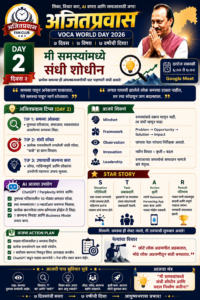 Day 2 – Opportunity Recognition & Problem Solving
Theme
Think Like an Entrepreneur
Learning Objectives
- Identify opportunities hidden in problems
- Learn structured decision-making
- Develop innovation mindset
Modules
- Design Thinking
- Root Cause Analysis
- Opportunity Mapping
- Systems Thinking
- Critical Thinking
Frameworks
- Design Thinking
- Fishbone Diagram
- 5 Whys
- SCAMPER
- Lean Thinking
Case Studies
- Zerodha
- Amul
- Amazon
Activity
Solve a real-world community problem.
Deliverable
Innovation Proposal
Day 2 – Opportunity Recognition & Problem Solving
Think Like an Entrepreneur
“Every successful business began by solving a problem.”
Entrepreneurs don’t wait for opportunities—they create them. They see what others overlook: an inconvenience, a gap, an unmet need, or an inefficient process. Where most people see obstacles, entrepreneurs see possibilities.
The ability to recognize opportunities and solve problems systematically is one of the most valuable skills in today’s rapidly changing world. Whether you aspire to launch a startup, lead a team, innovate within an organization, or create social impact, entrepreneurial thinking empowers you to identify value and transform ideas into meaningful outcomes.
This session introduces participants to proven frameworks used by global innovators and business leaders to identify problems, generate creative solutions, validate ideas, and create sustainable impact.
Why Entrepreneurial Thinking Matters
Every day, we encounter problems:
-
Long queues at hospitals
-
Traffic congestion
-
Inefficient government services
-
Lack of quality education
-
Agricultural challenges
-
Waste management issues
-
Financial inclusion gaps
While most people complain about these issues, entrepreneurs ask a different question:
“How can this problem become an opportunity?”
The world’s most successful companies—including Amazon, Uber, Airbnb, and Paytm—were born by addressing real problems experienced by millions of people.
Entrepreneurial thinking is not limited to starting a business. It is a mindset of curiosity, creativity, resilience, and action that enables individuals to create value in any domain.
Learning Objectives
By the end of this session, participants will be able to:
-
Identify opportunities hidden within everyday problems.
-
Apply structured approaches to problem-solving.
-
Develop innovative and customer-centric solutions.
-
Analyze systems to understand root causes.
-
Evaluate ideas using proven innovation frameworks.
-
Build confidence in creating impactful solutions for society.
Module 1: Design Thinking
What is Design Thinking?
Design Thinking is a human-centered approach to innovation that focuses on understanding users, challenging assumptions, redefining problems, and creating practical solutions.
Rather than beginning with technology or products, Design Thinking starts with empathy—understanding the people affected by the problem.
The Five Stages of Design Thinking
1. Empathize
Observe and understand the needs, emotions, and experiences of users.
Ask:
-
Who is facing the problem?
-
What frustrations do they experience?
-
Why does this problem matter?
Example: Interview local shopkeepers to understand challenges in adopting digital payments.
2. Define
Clearly articulate the problem.
Instead of saying:
“Farmers need better technology.”
Define the problem as:
“Small farmers struggle to access affordable weather forecasts and market prices.”
A well-defined problem is easier to solve.
3. Ideate
Generate multiple possible solutions without judging them initially.
Brainstorm using techniques such as:
-
Mind Mapping
-
Brainwriting
-
Crazy 8s
-
Reverse Thinking
Quantity often leads to quality.
4. Prototype
Create a simple version of the solution.
Examples:
-
Sketches
-
Wireframes
-
Mock-ups
-
Paper models
-
Clickable app prototypes
The goal is rapid learning, not perfection.
5. Test
Gather feedback from real users.
Ask:
-
What worked?
-
What confused users?
-
What can be improved?
Testing reduces risk and increases the likelihood of success.
Module 2: Root Cause Analysis
Solving the Right Problem
Many organizations waste time solving symptoms rather than underlying causes.
Example
Problem:
Traffic congestion near schools.
Surface solution:
Build a larger parking lot.
Root causes may include:
-
Poor traffic management
-
Inadequate public transport
-
Lack of pedestrian infrastructure
-
School timing overlaps
By addressing the root causes, more effective and sustainable solutions emerge.
Root Cause Analysis Process
-
Define the problem.
-
Collect relevant data.
-
Identify possible causes.
-
Validate the root cause.
-
Implement corrective actions.
-
Monitor outcomes.
Module 3: Opportunity Mapping
Every problem creates opportunities.
Opportunity Mapping helps identify:
-
Customer pain points
-
Emerging trends
-
Technology enablers
-
Market gaps
-
Social needs
Opportunity Matrix
| Problem | Opportunity |
|---|---|
| Food waste | Food redistribution platform |
| Long hospital queues | Online appointment system |
| High electricity bills | Smart energy management |
| Water scarcity | IoT-based water monitoring |
| Student stress | AI-powered mental wellness assistant |
Questions to Discover Opportunities
-
What frustrates people daily?
-
Which tasks are repetitive?
-
What takes too much time?
-
What is expensive?
-
What can be automated?
-
What services are missing?
Module 4: Systems Thinking
Problems rarely exist in isolation.
Everything is interconnected.
Systems Thinking helps us understand how different factors influence one another.
Example
Traffic congestion is influenced by:
-
Road design
-
Public transportation
-
Population growth
-
Office timings
-
Urban planning
-
Parking availability
-
Weather conditions
Addressing only one factor may not solve the larger issue.
Systems Thinking Process
Observe the whole system.
↓
Identify stakeholders.
↓
Understand relationships.
↓
Recognize feedback loops.
↓
Predict consequences.
↓
Design sustainable interventions.
Module 5: Critical Thinking
Critical Thinking is the ability to analyze information objectively before making decisions.
Instead of asking:
“What do I believe?”
Ask:
“What does the evidence suggest?”
Characteristics of Critical Thinkers
-
Curious
-
Open-minded
-
Logical
-
Evidence-driven
-
Reflective
-
Analytical
Questions to Ask
-
Is this information reliable?
-
What assumptions am I making?
-
Are there alternative explanations?
-
What evidence supports this?
-
What are the risks?
Critical thinking improves decision quality and reduces bias.
Innovation Frameworks
1. Design Thinking
A structured approach to solving human-centered problems through empathy, experimentation, and iterative learning.
2. Fishbone Diagram (Cause-and-Effect Analysis)
The Fishbone Diagram, also known as the Ishikawa Diagram, helps identify potential causes of a problem across categories such as:
-
People
-
Process
-
Technology
-
Environment
-
Materials
-
Policies
This visual framework ensures that all possible contributing factors are considered before selecting solutions.
3. 5 Whys Technique
The 5 Whys is a simple yet powerful method for uncovering root causes by repeatedly asking “Why?”
Example
Problem:
Customer complaints have increased.
Why?
Delivery is delayed.
Why?
Orders are processed slowly.
Why?
Manual approvals take time.
Why?
The workflow is paper-based.
Why?
The organization has not implemented digital automation.
Root cause:
Outdated manual processes.
4. SCAMPER Framework
SCAMPER is a creativity tool that encourages innovation by examining an existing product or process through seven lenses:
-
Substitute – What can be replaced?
-
Combine – What can be merged?
-
Adapt – What can be borrowed?
-
Modify – What can be changed?
-
Put to another use – Can it serve a different purpose?
-
Eliminate – What is unnecessary?
-
Reverse/Rearrange – Can the order or structure be changed?
This framework helps teams generate fresh ideas and improve existing solutions.
5. Lean Thinking
Lean Thinking focuses on maximizing value while minimizing waste.
The core principles include:
-
Understand customer value.
-
Map the value stream.
-
Eliminate unnecessary activities.
-
Create smooth workflows.
-
Continuously improve (Kaizen).
Lean enables organizations to deliver better outcomes with fewer resources.
Case Studies
Zerodha – Simplifying Investing
Founded in 2010, Zerodha identified a major problem in India’s stock market: high brokerage fees and a complicated trading experience. By introducing a low-cost brokerage model, intuitive technology, and educational resources, it democratized investing for millions of first-time investors.
Entrepreneurial Lesson
Innovation often comes from making existing services simpler, more affordable, and more accessible.
Amul – Solving a Rural Livelihood Challenge
Amul transformed India’s dairy sector by organizing small farmers into cooperative societies. It addressed issues such as fragmented supply chains, low farmer incomes, and limited market access through a cooperative model that empowered producers while ensuring quality products for consumers.
Entrepreneurial Lesson
Large-scale impact can be achieved by solving social problems through collaborative business models.
Amazon – Reinventing Customer Experience
Amazon began as an online bookstore but expanded by continuously identifying customer pain points. Fast delivery, personalized recommendations, secure payments, cloud computing, and customer-centric innovation helped it become one of the world’s largest technology companies.
Entrepreneurial Lesson
Customer obsession and continuous innovation are sustainable competitive advantages.
Activity: Solve a Real-World Community Problem
Participants will work in teams to identify and address a genuine issue affecting their community.
Step 1 – Observe
Spend time in your local area and note recurring problems such as:
-
Traffic congestion
-
Waste disposal
-
Water shortages
-
Public transportation
-
School dropouts
-
Digital illiteracy
-
Healthcare accessibility
Step 2 – Interview Stakeholders
Speak with residents, local officials, business owners, or community leaders to understand their perspectives and gather evidence.
Step 3 – Define the Problem
Write a clear problem statement that captures the issue and its impact on the community.
Step 4 – Analyze Root Causes
Use tools such as the Fishbone Diagram or the 5 Whys to identify the underlying factors contributing to the problem.
Step 5 – Generate Solutions
Brainstorm multiple ideas using Design Thinking and SCAMPER. Encourage creativity and avoid judging ideas too early.
Step 6 – Evaluate
Assess solutions based on:
-
Feasibility
-
Cost
-
Social impact
-
Scalability
-
Sustainability
Step 7 – Present
Prepare a short presentation outlining your analysis and recommended solution.
Deliverable: Innovation Proposal
Each participant or team will submit a concise innovation proposal containing:
-
Title of the Problem
-
Problem Statement
-
Evidence and Observations
-
Stakeholder Analysis
-
Root Cause Analysis
-
Opportunity Identified
-
Proposed Solution
-
Innovation Frameworks Applied
-
Implementation Plan
-
Expected Social and Economic Impact
-
Potential Risks and Mitigation Strategies
-
Success Metrics (KPIs)
Key Takeaways
By the end of Day 2, participants will:
-
Recognize that every meaningful innovation starts with understanding a real problem.
-
Use Design Thinking to create user-centered solutions.
-
Diagnose issues effectively through Root Cause Analysis and the 5 Whys.
-
Apply Systems Thinking to address complex challenges holistically.
-
Generate creative ideas using the SCAMPER framework.
-
Improve efficiency through Lean Thinking.
-
Strengthen critical thinking and evidence-based decision-making.
-
Develop an entrepreneurial mindset that seeks opportunities in uncertainty and creates value for individuals, organizations, and society.
“The entrepreneur is not someone who simply starts a business. An entrepreneur is someone who sees possibilities where others see problems, takes informed risks, and creates lasting value through purposeful action.”