
Introduction: Beyond Electricity – The Next Energy Frontier
India’s clean energy transition has been driven largely by renewable electricity generated through solar and wind power. Electric vehicles, smart grids, and renewable energy projects are helping reduce dependence on fossil fuels and move the nation toward a more sustainable future.
However, electricity alone cannot fully decarbonize every sector of the economy. Industries such as steel manufacturing, cement production, aviation, shipping, and heavy transportation require energy solutions that go beyond traditional electrification.
This is where green hydrogen emerges as a game-changing technology.
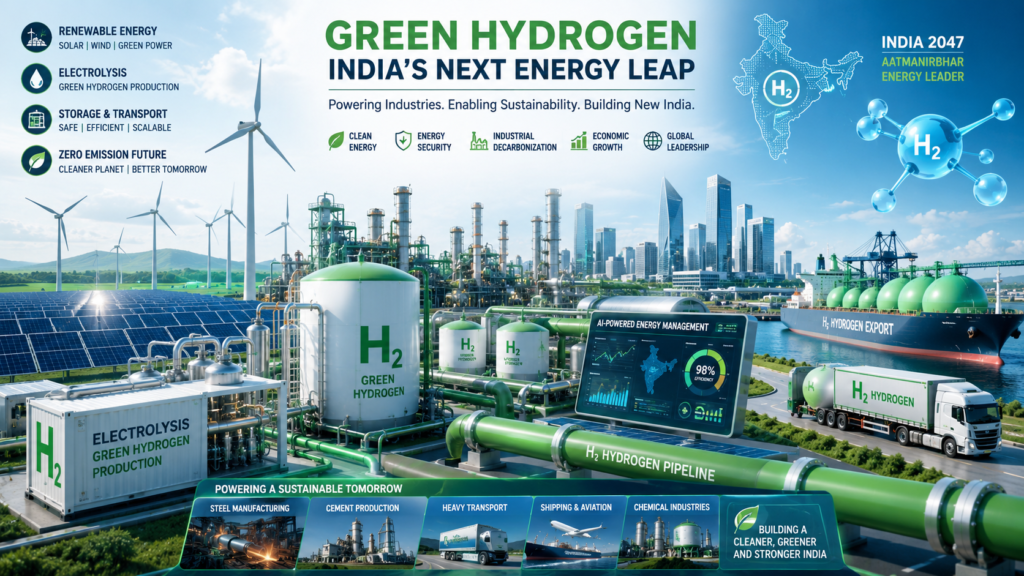
Produced using renewable energy sources, green hydrogen has the potential to transform India’s energy landscape, strengthen energy security, reduce carbon emissions, and create new economic opportunities. As India works toward its vision of becoming a developed nation by 2047, green hydrogen is expected to play a critical role in achieving long-term sustainability goals.
What Is Green Hydrogen?
Green hydrogen is hydrogen produced through the process of electrolysis, where water is split into hydrogen and oxygen using electricity generated from renewable energy sources such as solar and wind power.
Unlike grey hydrogen, which is produced using fossil fuels and generates carbon emissions, green hydrogen is considered a clean and environmentally friendly energy source.
Key characteristics of green hydrogen include:
- Zero carbon emissions during production
- Renewable energy-powered generation
- Long-term energy storage capabilities
- Versatile industrial applications
- Support for decarbonization goals
As countries around the world pursue net-zero targets, green hydrogen is increasingly viewed as a critical component of the global clean energy transition.
Why India Needs Green Hydrogen
India is one of the world’s fastest-growing economies and one of the largest energy consumers. While renewable energy adoption has accelerated significantly, several sectors remain difficult to electrify.
These sectors include:
- Steel manufacturing
- Cement production
- Chemical industries
- Aviation
- Shipping and logistics
- Heavy transportation
Traditional fossil fuels continue to dominate these industries, contributing significantly to greenhouse gas emissions.
Green hydrogen provides an opportunity to reduce emissions while supporting economic growth and industrial expansion.
The Government of India’s National Green Hydrogen Mission aims to accelerate hydrogen production, infrastructure development, and industrial adoption across the country.
https://mnre.gov.in/national-green-hydrogen-mission/?utm_source=chatgpt.com
Additionally, India imports a large portion of its energy requirements. Developing a domestic green hydrogen ecosystem can improve energy independence and reduce reliance on imported fossil fuels.
The Current Challenges
Although the future of green hydrogen looks promising, several challenges must be addressed before large-scale adoption becomes possible.
High Production Costs
Currently, producing green hydrogen is more expensive than producing conventional hydrogen derived from fossil fuels.
Reducing production costs will require:
- Technological advancements
- Economies of scale
- Increased renewable energy capacity
- Government support and incentives
Limited Infrastructure
Hydrogen requires specialized infrastructure for:
- Storage
- Transportation
- Distribution
- Refueling stations
Building this infrastructure will require significant investment from both public and private sectors.
Industrial Adoption
Many industries are still in the early stages of hydrogen integration.
Organizations need:
- Pilot projects
- Demonstration facilities
- Regulatory support
- Investment incentives
to accelerate adoption at scale.
Industry Insights: The Hydrogen Economy Is Emerging
The global hydrogen economy is expanding rapidly as governments and businesses invest in clean energy solutions.
India is uniquely positioned to become a major player due to:
- Abundant solar energy resources
- Growing wind energy capacity
- Large industrial demand
- Strong government support
- Strategic geographic location
Major companies are already investing in hydrogen production facilities, renewable energy infrastructure, and export opportunities.
India’s vast renewable energy capacity gives it a significant advantage in scaling green hydrogen production.
Link : https://www.irena.org/?utm_source=chatgpt.com
Several trends are driving the growth of the hydrogen economy:
Falling Renewable Energy Costs
The cost of solar and wind energy has declined significantly, making green hydrogen production more economically viable.
Advancements in Electrolysis Technology
Modern electrolyzers are becoming more efficient, reducing production costs and increasing scalability.
Rising Global Demand
Many countries are seeking clean fuel alternatives to achieve their climate goals, creating significant export opportunities for green hydrogen producers.
Strategic Solutions for Building India’s Hydrogen Ecosystem
1. Renewable-Powered Hydrogen Production
Green hydrogen must be produced using renewable energy to ensure environmental sustainability.
Key priorities include:
- Expanding solar energy capacity
- Increasing wind power generation
- Developing large-scale electrolysis facilities
- Integrating renewable energy with hydrogen production
This approach ensures low-carbon fuel production while maximizing renewable energy utilization.
2. Hydrogen Storage and Distribution Infrastructure
For hydrogen to become a mainstream energy source, India must invest in infrastructure such as:
- Hydrogen storage facilities
- Pipeline networks
- Transportation systems
- Export terminals
- Refueling stations
Strong infrastructure will support both domestic consumption and international trade.
3. Industrial Integration
The fastest adoption of green hydrogen is expected in industrial sectors.
Potential applications include:
- Hydrogen-based steel manufacturing
- Green chemical production
- Sustainable refining processes
- Heavy-duty transportation
Industrial adoption can significantly reduce emissions while improving operational sustainability.
4. AI and Digital Technologies
Technology will play a crucial role in optimizing hydrogen production and distribution.
Applications include:
- AI-powered energy management
- Predictive maintenance systems
- Demand forecasting
- Production optimization
- Smart grid integration
These innovations can improve efficiency and reduce operational costs.
Use Case: Gujarat as a Hydrogen Hub
Gujarat is emerging as one of India’s most promising regions for green hydrogen development.
The state offers:
- Strong renewable energy capacity
- Industrial manufacturing clusters
- Port infrastructure
- Export opportunities
A future hydrogen ecosystem in Gujarat could include:
- Solar-powered hydrogen plants
- Hydrogen-based industrial operations
- Dedicated export facilities
- Smart energy management systems
This integrated model could serve as a blueprint for hydrogen development across India.
Benefits of Green Hydrogen for India
The adoption of green hydrogen can deliver multiple benefits.
Reduced Carbon Emissions
Hydrogen can replace fossil fuels in difficult-to-decarbonize sectors, supporting climate goals.
Improved Energy Security
Domestic hydrogen production reduces dependence on imported fuels.
Economic Growth
The hydrogen economy can create new industries, investments, and employment opportunities.
Global Competitiveness
India can position itself as a leading producer and exporter of clean hydrogen.
Industrial Innovation
Green hydrogen encourages technological advancement and modernization across industries.
Future Outlook: India’s Hydrogen Economy by 2047
The future of green hydrogen in India looks extremely promising.
Over the next two decades, experts expect:
- Significant reductions in production costs
- Expansion of hydrogen infrastructure
- Large-scale industrial adoption
- Growth in hydrogen exports
- Integration with renewable energy ecosystems
Hydrogen is expected to become a key pillar of India’s clean energy strategy and economic development.
As technology improves and investments increase, green hydrogen could help India transition from a major energy importer to a global clean energy leader.
Conclusion: From Energy Consumer to Energy Leader
Green hydrogen represents one of the most important opportunities in India’s energy transition journey.
While challenges related to cost, infrastructure, and adoption remain, the long-term benefits far outweigh the obstacles. Through innovation, investment, policy support, and industry collaboration, India can build a thriving hydrogen economy that supports sustainable growth and energy independence.
Green hydrogen has the potential to transform industries, create economic opportunities, reduce carbon emissions, and strengthen India’s position in the global energy market.
To learn more about our expertise in energy innovation, digital transformation, and future-ready technologies, visit our About Us page.
Interested in sustainable energy strategies and emerging technologies? Feel free to Contact Us to learn how we can help.
https://morepublicconnect.in/contact/
Frequently Asked Questions (FAQs)
What is green hydrogen?
Green hydrogen is hydrogen produced using renewable energy sources such as solar and wind power through a process called electrolysis.
Why is green hydrogen important for India?
Green hydrogen can help reduce emissions, improve energy security, support industrial decarbonization, and create new economic opportunities.
What is the National Green Hydrogen Mission?
The National Green Hydrogen Mission is an initiative by the Government of India to promote hydrogen production, infrastructure development, and adoption across industries.
Which industries can benefit from green hydrogen?
Industries such as steel, cement, chemicals, shipping, aviation, refining, and heavy transportation can benefit significantly from hydrogen adoption.
Can India become a global exporter of green hydrogen?
Yes. With abundant renewable energy resources and growing investments, India has the potential to become a major exporter of green hydrogen in the coming decades.
🚀 Ready to Transform Your Business?
From AI and Agentic AI to Cloud, Data, Automation, and Digital Transformation, KPSmart IT Solutions helps businesses turn technology opportunities into measurable business outcomes.
Have a challenge? Have an idea? Let’s talk.
👉 Explore KPSmart IT Solutions
KPSmart IT Solutions — Build Smart. Automate. Transform. Grow.
#KPSmartITSolutions #AI #ArtificialIntelligence #AgenticAI #DigitalTransformation #BusinessAutomation #EnterpriseAI #Innovation