
 Introduction
In today’s fast-paced and highly competitive business environment, companies are constantly searching for ways to improve efficiency, reduce operational costs, and meet customer demands more effectively. One of the most successful inventory management strategies used worldwide is the Just-in-Time (JIT) system.
Whether you’re a student, entrepreneur, supply chain professional, or business owner, understanding JIT can help you appreciate how modern organizations optimize production and inventory management. This guide explains what Just-in-Time is, how it works, its benefits, challenges, and why it remains a powerful business strategy.
What Is Just-in-Time (JIT)?
Just-in-Time (JIT) is an inventory management and production strategy where materials, components, and products are received or manufactured only when they are needed. Instead of maintaining large inventories, businesses keep stock levels low and replenish resources based on actual demand.
The primary objective of JIT is to eliminate waste, reduce storage costs, and improve operational efficiency. By producing only what customers need, companies can avoid excess inventory and maximize resource utilization.
The Origins of Just-in-Time
The Just-in-Time methodology gained global recognition through the Toyota Production System (TPS) in Japan after World War II. Due to limited resources and financial constraints, Toyota developed a system focused on producing vehicles efficiently while minimizing waste.
This approach revolutionized manufacturing by introducing lean principles that emphasized:
- Continuous improvement
- Waste reduction
- Quality control
- Efficient resource utilization
- Customer-focused production
Today, JIT principles are used across industries including manufacturing, retail, healthcare, logistics, and e-commerce.
How Does the JIT System Work?
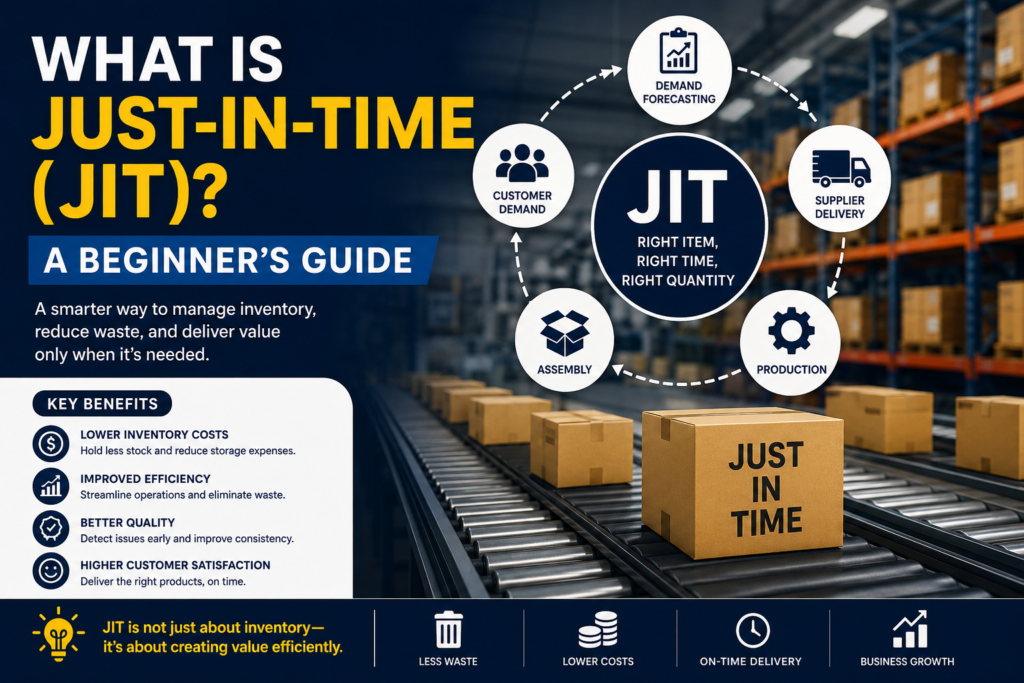
A Just-in-Time system operates by aligning production schedules with customer demand. Materials are ordered, received, and utilized only when required for manufacturing or order fulfillment.
The process typically involves:
1. Demand Forecasting
Businesses analyze customer demand to predict future requirements accurately.
2. Supplier Coordination
Reliable suppliers deliver materials precisely when needed to avoid production delays.
3. Efficient Production Scheduling
Production activities are carefully planned to ensure smooth workflows without excess inventory.
4. Continuous Monitoring
Inventory levels, supplier performance, and production efficiency are monitored regularly to prevent disruptions.
This streamlined process helps businesses maintain lean operations while meeting customer expectations.
Key Benefits of Just-in-Time Inventory Management
Reduced Inventory Costs
One of the biggest advantages of JIT is lower inventory holding costs. Businesses spend less money on storage facilities, warehousing, insurance, and inventory maintenance.
Improved Cash Flow
Since companies purchase inventory only when needed, less capital is tied up in stock. This improves cash flow and financial flexibility.
Reduced Waste
JIT minimizes overproduction and excess inventory, reducing waste and improving sustainability.
Enhanced Efficiency
Production processes become more streamlined because resources are available exactly when required.
Better Product Quality
Smaller production batches make it easier to identify and correct quality issues before they become widespread.
Increased Customer Satisfaction
By responding quickly to demand changes, businesses can improve delivery times and customer service.
Challenges of Implementing JIT
While JIT offers significant benefits, it also presents certain risks.
Supply Chain Disruptions
Any delay from suppliers can halt production because businesses maintain minimal inventory reserves.
Demand Fluctuations
Unexpected spikes in customer demand can create inventory shortages.
Supplier Dependence
Successful JIT systems require highly reliable suppliers capable of delivering materials consistently and on time.
Limited Buffer Stock
Since inventory levels are kept low, companies have less protection against unexpected disruptions.
Industries That Use Just-in-Time
JIT is widely adopted across multiple sectors:
Manufacturing
Automotive, electronics, and machinery manufacturers use JIT to reduce production costs.
Retail
Retailers use JIT to avoid overstocking and respond quickly to changing consumer preferences.
Healthcare
Hospitals use JIT systems to manage medical supplies efficiently while reducing storage requirements.
E-commerce
Online businesses utilize JIT principles to fulfill customer orders quickly without maintaining excessive inventory.
Best Practices for Successful JIT Implementation
Organizations can improve JIT success by following these practices:
- Build strong supplier relationships
- Invest in demand forecasting tools
- Use inventory management software
- Maintain effective communication across departments
- Continuously monitor performance metrics
- Develop contingency plans for supply chain disruptions
These practices help businesses maximize the benefits of lean inventory management.
The Future of Just-in-Time Inventory Management
Advancements in artificial intelligence, automation, and data analytics are making JIT systems even more effective. Businesses can now use real-time data to predict demand more accurately and optimize inventory levels.
As supply chains become increasingly digital, JIT will continue evolving to support smarter, faster, and more efficient business operations.
Conclusion
Just-in-Time (JIT) is a powerful inventory management strategy that helps businesses reduce costs, eliminate waste, and improve efficiency. By receiving materials only when needed, organizations can streamline operations and enhance customer satisfaction.
Although JIT requires careful planning and strong supplier relationships, its long-term benefits make it one of the most effective approaches to modern inventory management. Companies that successfully implement JIT can achieve greater agility, profitability, and competitive advantage in today’s dynamic business landscape.
🚀 Ready to Transform Your Business?
From AI and Agentic AI to Cloud, Data, Automation, and Digital Transformation, KPSmart IT Solutions helps businesses turn technology opportunities into measurable business outcomes.
Have a challenge? Have an idea? Let’s talk.
👉 Explore KPSmart IT Solutions
KPSmart IT Solutions — Build Smart. Automate. Transform. Grow.
#KPSmartITSolutions #AI #ArtificialIntelligence #AgenticAI #DigitalTransformation #BusinessAutomation #EnterpriseAI #Innovation