
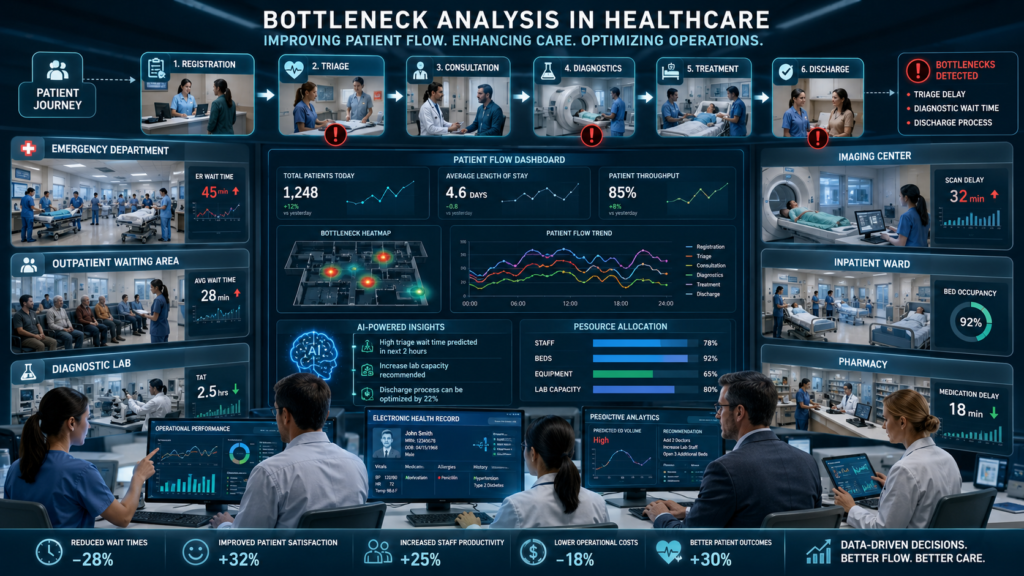

Introduction
Efficient patient flow is the foundation of high-quality healthcare delivery. Hospitals, clinics, and healthcare systems are under constant pressure to provide timely care while managing limited resources, increasing patient volumes, and rising operational costs.
Link : https://www.ihi.org
Despite advancements in healthcare technology, many organizations continue to struggle with bottlenecks that create delays throughout the patient journey. These bottlenecks can lead to overcrowded facilities, longer wait times, reduced staff productivity, and lower patient satisfaction.
Bottleneck analysis has emerged as a powerful process improvement strategy that helps healthcare organizations identify operational inefficiencies, optimize workflows, and enhance patient outcomes. By systematically identifying points of congestion, healthcare providers can implement targeted solutions that improve both efficiency and quality of care.
What Is Bottleneck Analysis?
Bottleneck analysis is a process improvement methodology used to identify stages within a workflow where delays, congestion, or resource limitations slow down overall performance.
Link : https://asq.org/quality-resources/process-improvement
In healthcare settings, bottlenecks occur when the demand for services exceeds available capacity, causing patients, staff, or information to become delayed at specific points in the care process.
Common healthcare bottlenecks may occur during:
- Patient registration
- Triage assessment
- Diagnostic testing
- Specialist consultations
- Treatment procedures
- Hospital admissions
- Patient discharge processes
Identifying these constraints allows healthcare organizations to focus their improvement efforts where they will have the greatest impact.
Why Bottleneck Analysis Matters in Healthcare
Healthcare organizations operate in complex environments where delays can directly affect patient outcomes and operational performance.
Effective bottleneck analysis helps organizations:
- Reduce patient wait times
- Improve resource utilization
- Increase patient throughput
- Enhance patient satisfaction
- Improve staff productivity
- Lower operational costs
- Support better clinical outcomes
By addressing workflow inefficiencies, hospitals can deliver faster, safer, and more patient-centered care.
Common Bottlenecks in Healthcare
1. Emergency Department Overcrowding
Emergency departments frequently experience high patient volumes, resulting in long waiting times and delayed treatment.
Common causes include:
- Limited bed availability
- Staffing shortages
- Delayed diagnostic results
- Slow admission processes
2. Diagnostic Testing Delays
Laboratory tests and imaging services often become bottlenecks when demand exceeds capacity.
Examples include:
- Long laboratory turnaround times
- Delayed radiology reports
- Equipment limitations
- Communication gaps between departments
3. Patient Discharge Delays
Patients who are medically ready to leave may remain in hospital beds due to administrative or logistical issues.
Factors include:
- Incomplete documentation
- Medication preparation delays
- Transportation challenges
- Care coordination issues
4. Resource Constraints
Limited healthcare resources can significantly affect operational efficiency.
Examples include:
- Staff shortages
- Limited equipment availability
- Insufficient treatment rooms
- Capacity management challenges
Steps for Conducting Bottleneck Analysis
Step 1: Map the Patient Journey
The first step is to visualize every stage of the patient experience from admission to discharge.
Patient journey mapping helps identify:
- Process flow
- Decision points
- Delays
- Resource requirements
Step 2: Collect Operational Data
Healthcare organizations should gather performance metrics such as:
- Average wait times
- Patient throughput rates
- Resource utilization levels
- Length of stay
- Appointment delays
Data-driven analysis provides objective insights into operational performance.
Step 3: Identify Bottlenecks
Review workflow data to determine where delays consistently occur.
Indicators include:
- Long queues
- Excessive waiting periods
- Underutilized resources
- Workflow interruptions
Step 4: Analyze Root Causes
Healthcare leaders should investigate why bottlenecks occur.
Common methods include:
- The 5 Whys technique
- Fishbone diagrams
- Process mapping workshops
- Staff interviews
Step 5: Implement Targeted Solutions
Once root causes are identified, organizations can implement corrective actions such as:
- Workflow redesign
- Staff reallocation
- Automation technologies
- Capacity expansion
- Process standardization
Step 6: Monitor and Optimize
Continuous monitoring ensures that improvements remain effective over time.
Organizations should regularly review performance metrics and make adjustments when necessary.
Real-World Example
A community hospital experienced excessive patient wait times within its emergency department. Through bottleneck analysis, leadership discovered that delayed laboratory results were creating significant congestion throughout the patient care process.
The hospital introduced point-of-care testing technology, improved communication workflows, and optimized staffing schedules.
As a result:
- Emergency department wait times decreased significantly
- Patient throughput improved
- Staff productivity increased
- Patient satisfaction scores improved
This example demonstrates how targeted interventions can deliver measurable operational improvements.
The Role of Technology in Bottleneck Reduction
Modern healthcare organizations increasingly rely on technology to identify and address operational inefficiencies.
Examples include:
Healthcare Analytics
Analytics platforms provide real-time visibility into patient flow and operational performance.
Link : https://www.healthit.gov
Artificial Intelligence
AI systems can predict patient volumes, identify risks, and recommend resource allocation strategies.
Electronic Health Records (EHR)
Integrated EHR systems improve communication and reduce administrative delays.
Automation Solutions
Automation reduces manual processes and accelerates routine administrative tasks.
Future Outlook
The future of healthcare operations will increasingly focus on data-driven decision-making, predictive analytics, and intelligent workflow management.
Emerging trends include:
- AI-powered patient flow optimization
- Predictive capacity planning
- Smart hospital technologies
- Digital twin healthcare modeling
- Real-time operational monitoring
Organizations that embrace these innovations will be better positioned to improve efficiency while delivering exceptional patient care.
Benefits of Bottleneck Analysis in Healthcare
Healthcare organizations that invest in bottleneck analysis can achieve numerous benefits:
- Faster patient throughput
- Reduced wait times
- Improved patient satisfaction
- Enhanced staff productivity
- Better resource utilization
- Lower operational costs
- Improved clinical outcomes
- Stronger organizational performance
These benefits contribute directly to long-term healthcare excellence.
Conclusion
Bottleneck analysis is an essential strategy for healthcare organizations seeking to improve patient flow, operational efficiency, and quality of care.
By identifying workflow constraints, analyzing root causes, and implementing targeted improvements, hospitals and clinics can reduce delays, optimize resources, and enhance patient outcomes.
As healthcare systems continue to evolve, organizations that embrace data-driven process improvement will be best positioned to deliver faster, safer, and more effective care.
To learn more about our expertise in healthcare innovation, digital transformation, and operational excellence, visit our About Us page.
https://morepublicconnect.in/about/
Interested in improving healthcare efficiency and patient outcomes? Feel free to Contact Us to learn how we can help.
https://morepublicconnect.in/contact/
Frequently Asked Questions (FAQs)
What is bottleneck analysis in healthcare?
Bottleneck analysis is a process improvement technique used to identify delays and constraints within healthcare workflows that affect patient care and operational efficiency.
Why is patient flow important in healthcare?
Efficient patient flow reduces wait times, improves patient satisfaction, optimizes resource utilization, and supports better clinical outcomes.
What are common healthcare bottlenecks?
Common bottlenecks include emergency department overcrowding, diagnostic testing delays, discharge delays, and resource constraints.
How can hospitals reduce bottlenecks?
Hospitals can reduce bottlenecks through workflow redesign, technology adoption, staff optimization, process automation, and continuous performance monitoring.
What role does technology play in bottleneck analysis?
Technology enables real-time monitoring, predictive analytics, workflow automation, and data-driven decision-making that improve operational efficiency.
🚀 Ready to Transform Your Business?
From AI and Agentic AI to Cloud, Data, Automation, and Digital Transformation, KPSmart IT Solutions helps businesses turn technology opportunities into measurable business outcomes.
Have a challenge? Have an idea? Let’s talk.
👉 Explore KPSmart IT Solutions
KPSmart IT Solutions — Build Smart. Automate. Transform. Grow.
#KPSmartITSolutions #AI #ArtificialIntelligence #AgenticAI #DigitalTransformation #BusinessAutomation #EnterpriseAI #Innovation