
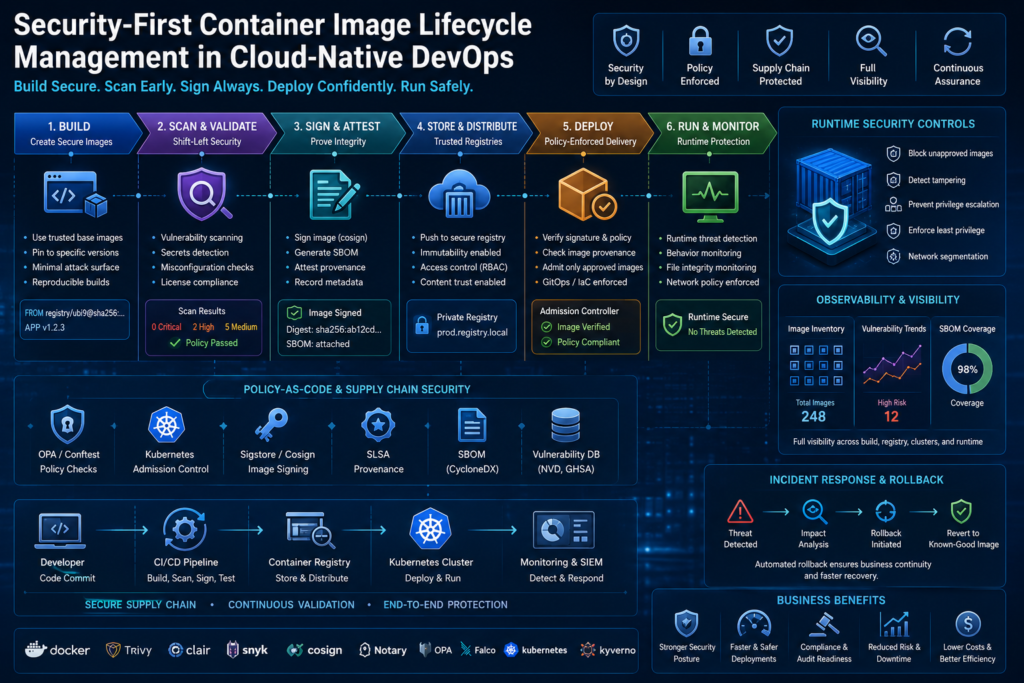
Containers have become the standard method for building, deploying, and managing applications in modern cloud-native environments. They provide consistency, scalability, and portability across development and production environments. However, as organizations increasingly rely on containerized applications, container images have become critical security assets that require continuous governance and protection. Security-first container image lifecycle management ensures that every image is created, validated, stored, deployed, and monitored according to defined security standards, helping organizations reduce risks and strengthen their software supply chain.
A secure container image lifecycle begins during the image creation process. Development teams should use trusted and verified base images obtained from approved registries instead of relying on unknown or unmaintained sources. Every image should be built using reproducible processes and pinned to specific versions rather than using dynamic tags that may introduce unexpected changes. Standardized image-building practices improve consistency, increase visibility, and help organizations maintain control over the components used throughout the application lifecycle.
Security validation must be integrated directly into development and deployment workflows. Modern DevSecOps pipelines can automatically scan container images for vulnerabilities, exposed secrets, malware, outdated dependencies, and configuration weaknesses before they are promoted to production environments. Automated policy enforcement ensures that images failing security requirements are blocked from deployment until issues are resolved. This proactive approach reduces the likelihood of vulnerable software reaching production systems and minimizes security risks across cloud-native environments.
Image authenticity and integrity are equally important aspects of container security. Image signing and provenance verification allow organizations to confirm that container images originate from trusted sources and have not been modified during distribution. CI/CD pipelines and container orchestration platforms can enforce signature verification policies, ensuring that only approved and validated images are deployed. This additional layer of protection helps defend against software supply chain attacks and prevents unauthorized or tampered images from entering production environments.
Continuous monitoring and runtime protection extend security beyond the deployment stage. Organizations should implement monitoring solutions that provide visibility into container behavior, detect anomalous activities, and identify attempts to run unauthorized images. Security teams can leverage observability platforms to monitor image usage across environments, investigate suspicious behavior, and respond quickly to potential threats. Automated rollback capabilities further enhance resilience by allowing teams to restore previously approved image versions whenever security concerns arise.
As cloud-native adoption continues to accelerate, organizations must adopt comprehensive strategies for securing containerized workloads. Security-first container image lifecycle management provides a structured framework that protects applications throughout development, deployment, and runtime operations. By combining trusted image sources, automated security scanning, image signing, policy enforcement, continuous monitoring, and governance controls, businesses can strengthen software supply chain security, improve operational resilience, and build more secure cloud-native infrastructures capable of supporting long-term growth and innovation.
🚀 Ready to Transform Your Business?
From AI and Agentic AI to Cloud, Data, Automation, and Digital Transformation, KPSmart IT Solutions helps businesses turn technology opportunities into measurable business outcomes.
Have a challenge? Have an idea? Let’s talk.
👉 Explore KPSmart IT Solutions
KPSmart IT Solutions — Build Smart. Automate. Transform. Grow.
#KPSmartITSolutions #AI #ArtificialIntelligence #AgenticAI #DigitalTransformation #BusinessAutomation #EnterpriseAI #Innovation