
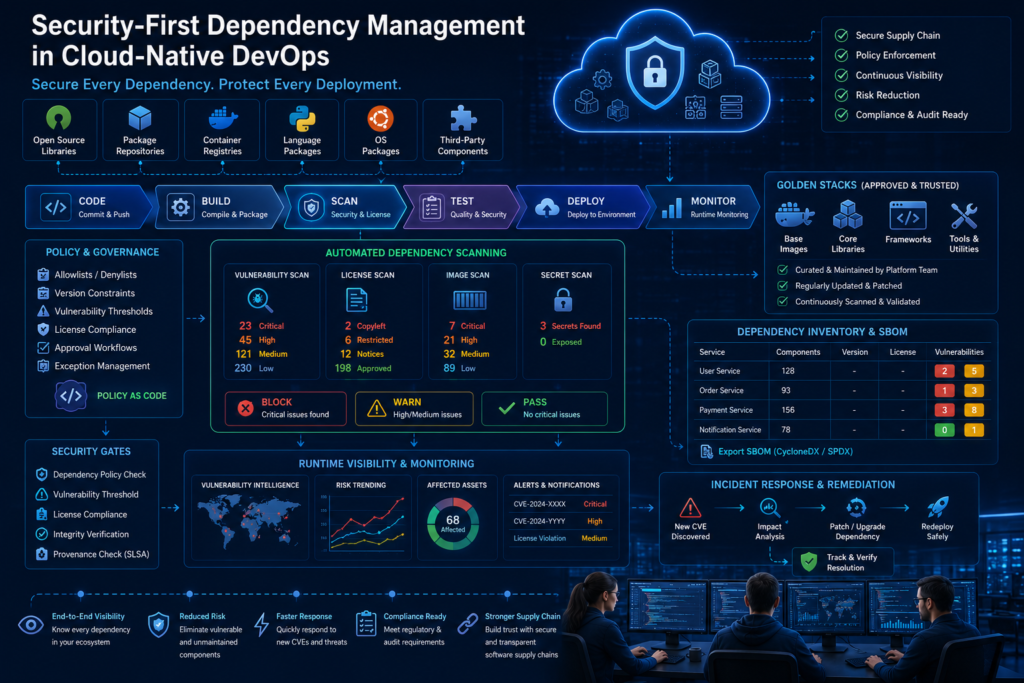
Security-first dependency management has become a critical component of modern cloud-native DevOps practices. Modern applications rely extensively on third-party libraries, open-source frameworks, container images, and software packages sourced from external repositories. While these dependencies accelerate software development and reduce implementation time, they can also introduce security vulnerabilities that impact application stability, compliance, and overall security. As a result, organizations must treat every dependency as a security-sensitive asset and establish governance processes that ensure dependencies remain secure throughout their lifecycle.
In cloud-native environments, applications often consist of numerous interconnected services that depend on a wide range of external components. A single vulnerable or outdated dependency can expose multiple systems to cyber threats, making dependency visibility and control essential. Security-first dependency management helps organizations identify, assess, and monitor third-party components before they become operational risks. Through structured governance policies and automated controls, development teams can reduce exposure to known vulnerabilities while maintaining the speed and flexibility required in modern DevOps workflows.
Automated dependency scanning plays a key role in protecting the software supply chain. Modern CI/CD pipelines continuously evaluate application dependencies, container images, operating system packages, and open-source libraries against trusted vulnerability databases and organizational security policies. When unsupported components or critical vulnerabilities are detected, automated systems can generate alerts, block deployments, or initiate remediation workflows. This proactive approach helps prevent vulnerable software from entering production environments and reduces the likelihood of security incidents.
Software Bill of Materials (SBOM) capabilities further strengthen dependency management by providing a detailed inventory of all software components used across applications and services. With clear visibility into software dependencies, security teams can quickly identify affected systems when new vulnerabilities are disclosed and prioritize remediation efforts effectively. Combined with monitoring and observability tools, SBOMs enable organizations to improve incident response, enhance compliance readiness, and maintain greater control over their software ecosystems.
Organizations can further improve security by adopting standardized technology stacks and approved dependency catalogs. Platform teams can maintain trusted base images, validated libraries, and approved frameworks that development teams can use confidently. This approach reduces dependency sprawl, improves consistency across projects, and minimizes the introduction of unverified or poorly maintained components into production environments.
As software supply chain attacks continue to grow in sophistication and frequency, organizations must take a proactive approach to dependency governance. Security-first dependency management enables development, operations, and security teams to collaborate more effectively while maintaining visibility across the entire software supply chain. By combining automated scanning, policy-based controls, SBOM visibility, approved technology standards, and continuous monitoring, businesses can reduce software supply chain risks, improve compliance, strengthen application security, and build more resilient cloud-native environments.
🚀 Ready to Transform Your Business?
From AI and Agentic AI to Cloud, Data, Automation, and Digital Transformation, KPSmart IT Solutions helps businesses turn technology opportunities into measurable business outcomes.
Have a challenge? Have an idea? Let’s talk.
👉 Explore KPSmart IT Solutions
KPSmart IT Solutions — Build Smart. Automate. Transform. Grow.
#KPSmartITSolutions #AI #ArtificialIntelligence #AgenticAI #DigitalTransformation #BusinessAutomation #EnterpriseAI #Innovation