
Introduction
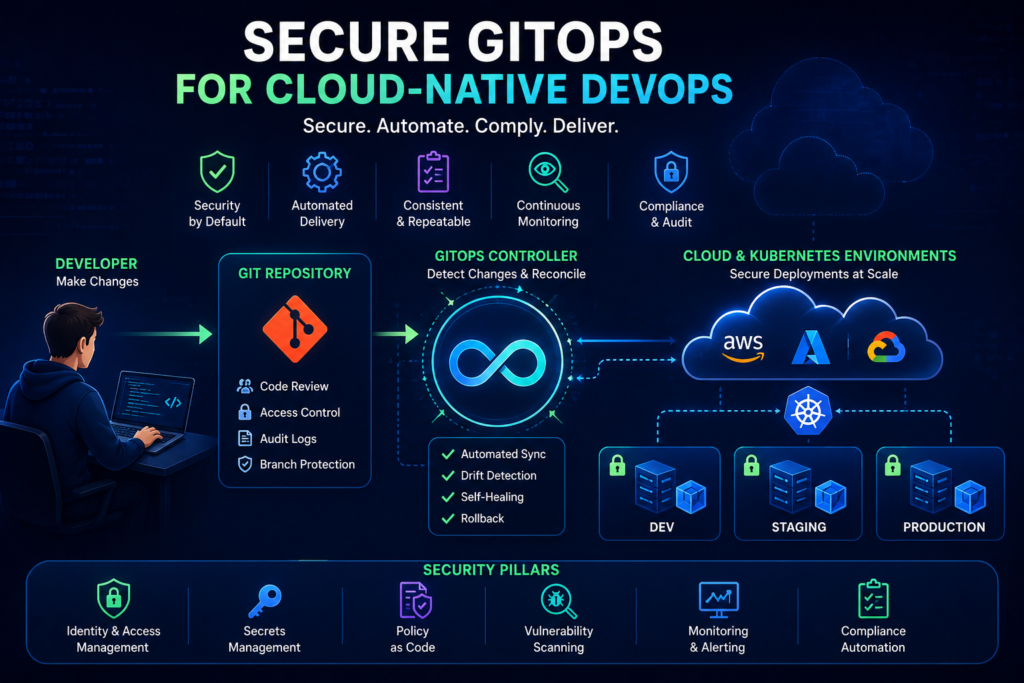
Secure GitOps for Cloud-Native DevOps has become a critical strategy for organizations seeking to improve deployment reliability, security, and operational efficiency. As cloud-native applications continue to grow in complexity, managing infrastructure and application deployments manually increases the risk of errors, security vulnerabilities, and compliance issues.
GitOps provides a modern operational framework where Git repositories act as the single source of truth for infrastructure and application configurations. However, organizations must implement Secure GitOps for Cloud-Native DevOps to protect source code, deployment pipelines, credentials, and cloud environments from cyber threats.
Therefore, businesses that adopt secure GitOps practices can strengthen security, accelerate deployments, and maintain greater control over cloud-native infrastructure.
What Is GitOps?
GitOps is an operational model that uses Git repositories to manage infrastructure, applications, and deployment configurations. Every change is defined through code, reviewed through pull requests, and automatically deployed using continuous delivery tools.
Key GitOps principles include:
- Git as the single source of truth
- Declarative infrastructure management
- Automated deployments
- Version-controlled changes
- Continuous reconciliation
As a result, teams gain better visibility, consistency, and control over cloud-native environments.
Why Secure GitOps Matters
While GitOps improves automation and scalability, it also introduces security challenges that organizations must address proactively.
Unauthorized Repository Access
Git repositories contain sensitive deployment configurations and infrastructure definitions. Consequently, unauthorized access can expose critical systems and business data.
Configuration Drift
Without proper controls, environments may deviate from approved configurations. Therefore, organizations must continuously monitor and validate deployments.
Secret Exposure
API keys, tokens, and credentials may accidentally be committed to repositories. Furthermore, exposed secrets can become entry points for attackers.
Supply Chain Risks
Modern applications depend on multiple external components and automation tools. As a result, compromised dependencies can impact entire deployment pipelines.
Core Components of Secure GitOps for Cloud-Native DevOps
Git Repository Security
Repositories should be protected using strong security controls.
Best practices include:
- Multi-factor authentication
- Role-based access control
- Branch protection rules
- Mandatory code reviews
- Audit logging
Additionally, organizations should monitor repository activities to detect suspicious behavior.
Infrastructure as Code Security
Infrastructure as Code (IaC) enables automated provisioning of cloud resources. However, misconfigured templates can create significant security risks.
Organizations should:
- Scan infrastructure templates
- Validate configurations automatically
- Apply secure coding standards
- Conduct peer reviews
Therefore, security issues can be identified before deployment.
Continuous Deployment Security
Automated deployment pipelines must be secured throughout the software delivery lifecycle.
Recommended controls include:
- Pipeline access restrictions
- Secure build environments
- Automated security testing
- Deployment verification
Consequently, organizations can reduce deployment-related risks.
Secret Management
Secure GitOps for Cloud-Native DevOps requires robust secret management practices.
Instead of storing secrets directly in repositories, organizations should use:
- Dedicated secret management platforms
- Encrypted secrets
- Dynamic credentials
- Automated secret rotation
Moreover, continuous monitoring helps detect credential misuse.
Best Practices for Secure GitOps for Cloud-Native DevOps
Implement Zero Trust Security
Zero Trust assumes that no user, device, or system should be trusted automatically.
Organizations should:
- Verify identities continuously
- Enforce least-privilege access
- Monitor user activities
- Limit resource permissions
As a result, unauthorized access risks are significantly reduced.
Enable Policy as Code
Policy as Code allows organizations to automate security and compliance requirements.
Benefits include:
- Consistent policy enforcement
- Faster compliance validation
- Reduced human error
- Improved governance
Furthermore, automated policies support scalable cloud-native operations.
Automate Security Scanning
Security testing should be integrated directly into GitOps workflows.
Important scanning activities include:
- Vulnerability assessments
- Container image scanning
- Dependency analysis
- Infrastructure configuration reviews
Therefore, security issues can be resolved earlier in the development process.
Secure Kubernetes Environments
Most GitOps deployments rely heavily on Kubernetes platforms.
Organizations should secure:
- Cluster configurations
- Workload permissions
- Network policies
- Admission controls
Additionally, Kubernetes monitoring helps identify abnormal behavior and configuration weaknesses.
Monitor Configuration Changes
Continuous monitoring helps organizations maintain visibility into configuration updates.
Benefits include:
- Faster issue detection
- Improved compliance
- Better audit readiness
- Enhanced operational stability
Consequently, organizations can maintain secure and predictable environments.
Benefits of Secure GitOps for Cloud-Native DevOps
Improved Security
Automated security controls reduce human errors and strengthen infrastructure protection.
Enhanced Compliance
Version-controlled configurations simplify compliance monitoring and auditing.
Faster Deployments
Automation enables rapid and consistent software delivery.
Better Visibility
Organizations gain complete visibility into infrastructure and application changes.
Reduced Operational Risks
Continuous validation helps prevent configuration drift and deployment failures.
Common Challenges
Despite its advantages, Secure GitOps for Cloud-Native DevOps presents several challenges.
These include:
- Managing secrets securely
- Complex Kubernetes environments
- Access control management
- Multi-cloud integration
- Compliance requirements
However, organizations can overcome these challenges through automation, governance frameworks, and continuous security monitoring.
Emerging Trends in GitOps Security
AI-Powered Security Monitoring
Artificial intelligence is helping identify anomalies and security risks faster than traditional monitoring approaches.
Automated Compliance Validation
Organizations are increasingly automating compliance checks within GitOps workflows.
Security as Code
Security policies are becoming integrated directly into infrastructure and deployment processes.
Unified Security Platforms
Centralized platforms provide visibility across repositories, pipelines, cloud environments, and Kubernetes clusters.
Future Outlook
As organizations continue adopting cloud-native architectures, GitOps will play an increasingly important role in managing infrastructure and application deployments. Therefore, security must remain a core component of GitOps strategies.
Businesses that implement Secure GitOps for Cloud-Native DevOps will gain stronger security, improved compliance, and greater operational resilience. Furthermore, secure automation will enable organizations to scale cloud-native operations confidently while reducing cyber risks.
Conclusion
Secure GitOps for Cloud-Native DevOps helps organizations combine automation, consistency, and security within modern software delivery pipelines. By securing repositories, protecting secrets, implementing Policy as Code, and continuously monitoring environments, businesses can significantly reduce risks while accelerating innovation.
Ultimately, organizations that embrace Secure GitOps for Cloud-Native DevOps will be better prepared to manage future cybersecurity challenges and maintain secure, reliable cloud-native operations.
Frequently Asked Questions
What is GitOps?
GitOps is an operational model that uses Git repositories as the single source of truth for managing infrastructure and application deployments.
Why is GitOps important for cloud-native environments?
GitOps improves automation, consistency, visibility, and deployment reliability in cloud-native infrastructures.
How can organizations secure GitOps workflows?
Organizations should implement repository security, secret management, automated security testing, and continuous monitoring.
What is Policy as Code?
Policy as Code automates security and compliance rules, ensuring consistent enforcement across environments.
What are the benefits of Secure GitOps for Cloud-Native DevOps?
Benefits include improved security, faster deployments, enhanced compliance, reduced operational risks, and better infrastructure visibility.
🚀 Ready to Transform Your Business?
From AI and Agentic AI to Cloud, Data, Automation, and Digital Transformation, KPSmart IT Solutions helps businesses turn technology opportunities into measurable business outcomes.
Have a challenge? Have an idea? Let’s talk.
👉 Explore KPSmart IT Solutions
KPSmart IT Solutions — Build Smart. Automate. Transform. Grow.
#KPSmartITSolutions #AI #ArtificialIntelligence #AgenticAI #DigitalTransformation #BusinessAutomation #EnterpriseAI #Innovation