
Introduction: Why Sustainable Fashion Is Reshaping the Industry
The global fashion industry is one of the world’s largest economic sectors, but it is also among the biggest contributors to environmental pollution. Traditional fast fashion business models prioritize low production costs and rapid manufacturing cycles, often leading to excessive waste, high carbon emissions, water pollution, and unethical labor practices.
As environmental awareness continues to grow, businesses and consumers are shifting toward a more responsible approach known as the sustainable fashion business model. This model focuses on balancing profitability with environmental protection, ethical sourcing, and social responsibility.
Today, sustainability is no longer just a trend—it has become a competitive advantage. Sustainable business practices also align with the United Nations Sustainable Development Goals (SDGs), which encourage responsible production and consumption.Fashion brands that embrace sustainable practices are building stronger customer relationships, improving brand reputation, and preparing for a future where responsible business practices are essential.
https://sdgs.un.org/goals
What Is a Sustainable Fashion Business Model?
A sustainable fashion business model is a business strategy that minimizes environmental impact while promoting ethical production, responsible sourcing, and long-term value creation.
Unlike traditional fast fashion, sustainable fashion emphasizes quality, durability, and transparency throughout the supply chain.
Key principles include:
- Eco-friendly raw materials
- Ethical labor practices
- Circular fashion
- Waste reduction
- Responsible manufacturing
- Sustainable packaging
- Transparent supply chains
The objective is to create clothing that benefits consumers without harming people or the planet.
Why Sustainable Fashion Matters
The fashion industry consumes enormous amounts of water, energy, and raw materials while generating significant textile waste.
Several factors are accelerating the shift toward sustainability:
- Growing environmental awareness
- Consumer demand for ethical products
- Government sustainability initiatives
- ESG (Environmental, Social, and Governance) goals
- Circular economy adoption
- Responsible manufacturing practices
Businesses that adopt sustainable practices can improve customer loyalty while reducing long-term operational risks.
Challenges Facing Traditional Fashion
High Environmental Impact
Fast fashion contributes significantly to carbon emissions, water pollution, and landfill waste.
Excessive Textile Waste
Millions of garments are discarded each year due to overproduction and short product life cycles.
Unethical Labor Practices
Some manufacturers continue to rely on unsafe working conditions and unfair wages.
Resource Depletion
Traditional production consumes large quantities of water, chemicals, and non-renewable resources.
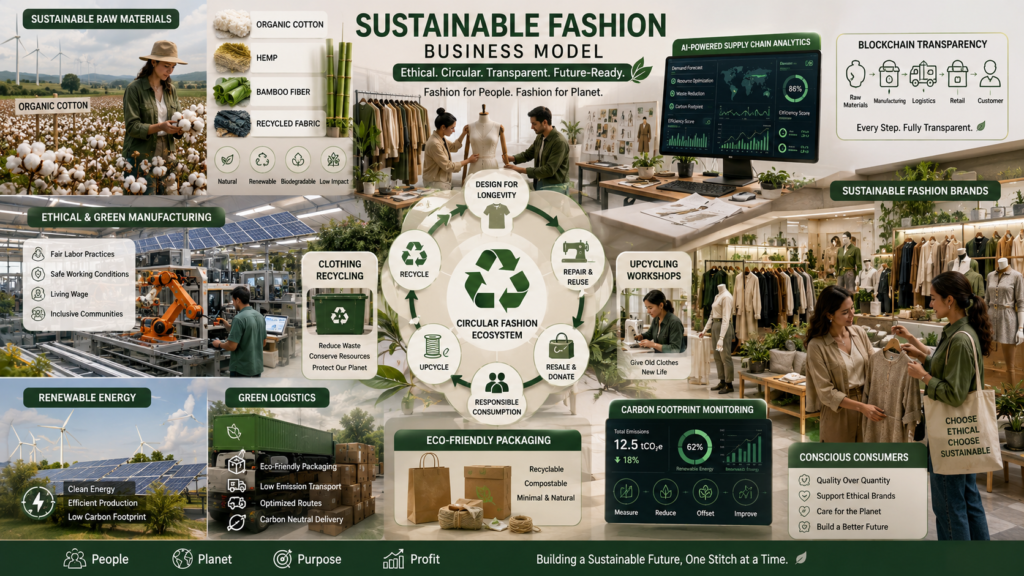
Key Elements of a Sustainable Fashion Business Model
1. Eco-Friendly Materials
Sustainable brands increasingly use:
- Organic cotton
Global Organic Textile Standard (GOTS).
https://global-standard.org - Recycled polyester
- Hemp
- Bamboo fibers
- Natural dyes
These materials reduce environmental impact while supporting responsible resource management.
2. Ethical Manufacturing
Responsible production includes:
- Fair wages
- Safe working conditions
- Responsible sourcing
- Worker welfare
- Transparent supply chains
Organizations such as Fashion Revolution encourage brands to improve transparency and accountability throughout the fashion supply chain.
https://www.fashionrevolution.org
Ethical manufacturing strengthens brand credibility and customer trust.
3. Circular Fashion
Instead of a “produce-use-discard” model, circular fashion promotes:
- Recycling
- Upcycling
- Clothing repair
- Rental fashion
- Product resale
This significantly reduces textile waste.
4. Technology-Driven Sustainability
Modern fashion brands increasingly use:
- Artificial Intelligence (AI)
- Supply chain analytics
- Blockchain for transparency
- Cloud computing
- Digital inventory management
Technology improves efficiency while reducing waste and overproduction.
Benefits of Sustainable Fashion
Businesses adopting sustainable fashion gain several competitive advantages.
Stronger Brand Loyalty
Consumers increasingly prefer brands that demonstrate environmental responsibility.
Reduced Environmental Impact
Sustainable production lowers waste, carbon emissions, and resource consumption.
Better Regulatory Compliance
Governments are introducing stricter environmental standards across manufacturing industries.
Long-Term Profitability
Although initial investment may be higher, sustainable businesses often experience stronger customer retention and higher lifetime value.
Future Trends in Sustainable Fashion
The fashion industry continues evolving through innovation and technology.
Emerging trends include:
- AI-powered demand forecasting
- Digital fashion
- Circular economy platforms
- Carbon-neutral manufacturing
- Smart textiles
- Sustainable supply chain analytics
- Renewable energy-powered factories
Organizations investing in these innovations will be better prepared for the future of fashion.
Best Practices for Fashion Businesses
Businesses looking to build sustainable fashion brands should:
- Source eco-friendly materials
- Reduce production waste
- Improve supply chain transparency
- Adopt circular economy principles
- Invest in sustainable packaging
- Leverage AI for inventory planning
- Educate consumers about sustainability
- Continuously measure environmental impact
Conclusion
The sustainable fashion business model represents a significant shift from volume-driven production toward responsible innovation and long-term value creation. By combining ethical manufacturing, eco-friendly materials, circular economy principles, and advanced technologies, fashion brands can reduce environmental impact while building stronger customer relationships.
As consumers increasingly prioritize sustainability, businesses that embrace responsible fashion today will be better positioned to lead tomorrow’s global marketplace.
To learn more about our expertise in sustainable business strategies and digital transformation, visit our About Us page.
https://morepublicconnect.in/about/
Looking to build a future-ready sustainable business model? Contact Us today to discover how we can help your organization achieve long-term growth.
https://morepublicconnect.in/contact/
Frequently Asked Questions (FAQs)
What is a sustainable fashion business model?
A sustainable fashion business model focuses on ethical manufacturing, eco-friendly materials, waste reduction, and long-term environmental responsibility.
Why is sustainable fashion important?
It helps reduce pollution, conserves natural resources, promotes ethical labor practices, and supports responsible consumption.
What materials are used in sustainable fashion?
Organic cotton, recycled fabrics, hemp, bamboo fibers, and natural dyes are commonly used.
How does technology support sustainable fashion?
AI, blockchain, cloud computing, and analytics improve supply chain transparency, demand forecasting, and inventory management.
What is the future of sustainable fashion?
The future includes circular economy models, AI-driven manufacturing, carbon-neutral production, digital fashion, and increased consumer demand for ethical products.
🚀 Ready to Transform Your Business?
From AI and Agentic AI to Cloud, Data, Automation, and Digital Transformation, KPSmart IT Solutions helps businesses turn technology opportunities into measurable business outcomes.
Have a challenge? Have an idea? Let’s talk.
👉 Explore KPSmart IT Solutions
KPSmart IT Solutions — Build Smart. Automate. Transform. Grow.
#KPSmartITSolutions #AI #ArtificialIntelligence #AgenticAI #DigitalTransformation #BusinessAutomation #EnterpriseAI #Innovation