
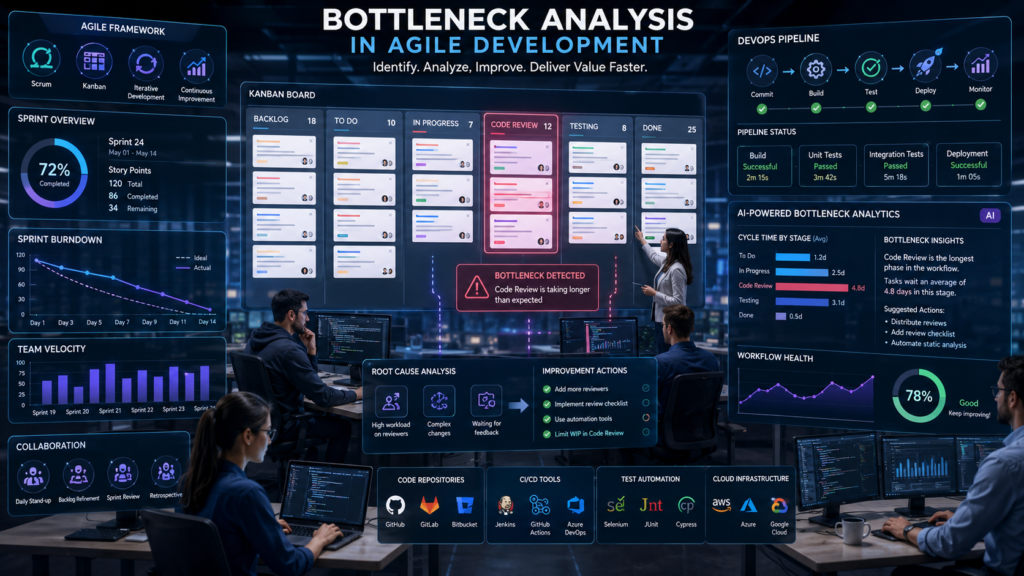

Introduction: Improving Agile Performance Through Bottleneck Analysis
Agile software development is built around collaboration, flexibility, and continuous improvement. Modern software teams aim to deliver high-quality applications quickly while adapting to changing customer requirements. However, even the most experienced Agile teams encounter workflow constraints that slow development and reduce productivity.
One of the most effective ways to identify and eliminate these constraints is through bottleneck analysis. By examining every stage of the software development lifecycle, teams can uncover delays, improve collaboration, and optimize delivery performance.
As organizations increasingly adopt Agile, Scrum, DevOps, and Continuous Integration/Continuous Deployment (CI/CD) practices, bottleneck analysis has become an essential strategy for maintaining development speed, improving software quality, and ensuring successful project delivery. Organizations can learn Agile and Scrum best practices through the Scrum Alliance.
https://www.scrumalliance.org
What is Bottleneck Analysis in Agile Development?
Bottleneck analysis is the process of identifying stages in a workflow where tasks accumulate faster than they can be completed. These constraints reduce productivity, increase delivery times, and create inefficiencies across Agile teams.
In Agile environments, bottlenecks commonly occur during:
- Backlog refinement
- Sprint planning
- Code development
- Code reviews
- Software testing
- Quality assurance (QA)
- Deployment
- Production releases
Identifying these constraints allows teams to improve workflow efficiency and maintain a steady delivery pace.
Why Bottleneck Analysis Matters for Agile Teams
Agile teams work within short development cycles known as sprints. A delay in one stage often impacts the entire project timeline.
Common challenges include:
- Delayed code reviews
- Slow testing cycles
- Limited QA resources
- Unclear user requirements
- Poor communication
- Manual deployment processes
- Technical debt
Regular bottleneck analysis helps teams resolve these issues before they affect product delivery.
Common Bottlenecks in Agile Software Development
1. Code Review Delays
Code review is essential for maintaining software quality, but overloaded reviewers can slow development significantly.
Solutions
- Assign multiple reviewers
- Use automated code quality tools
- Implement review time limits
2. Testing Bottlenecks
Manual testing often delays sprint completion.
Solutions
- Automated testing
- Continuous testing
- Parallel test execution
3. Deployment Delays
Manual deployment increases the risk of errors and release delays.
Solutions
- CI/CD pipelines
using tools such as Jenkins.
https://www.jenkins.io - Automated deployment
- Infrastructure as Code (IaC)
4. Resource Constraints
Teams sometimes rely heavily on one specialist for security, DevOps, or database tasks.
Solutions
- Cross-training
- Knowledge sharing
- Balanced workload distribution
5. Poor Communication
Miscommunication between developers, testers, and product owners can delay development.
Solutions
- Daily stand-ups
- Sprint retrospectives
- Shared documentation
- Collaborative planning
How Software Teams Perform Bottleneck Analysis
Visualize the Workflow
Agile teams commonly use Kanban boards to monitor every stage of development and identify where work begins to accumulate.
Measure Cycle Time
Tracking cycle time helps identify stages that consistently take longer than expected.
Perform Root Cause Analysis
Techniques such as the Five Whys and Fishbone Diagrams help teams understand why bottlenecks occur.
Implement Process Improvements
Teams introduce automation, improve collaboration, rebalance workloads, or redesign workflows based on their findings.
Monitor Results
Bottleneck analysis should be performed regularly to ensure improvements remain effective as projects evolve.
Technologies That Support Bottleneck Analysis
Modern Agile teams rely on various tools to monitor workflow performance.
Popular solutions include:
- Atlassian Jira
https://www.atlassian.com/software/jira - Azure DevOps
- GitHub
- GitLab
- Jenkins
- Trello
- Monday.com
- Power BI
These platforms provide real-time visibility into sprint progress, team productivity, deployment pipelines, and workflow efficiency.
Benefits of Bottleneck Analysis in Agile Development
Organizations implementing bottleneck analysis experience several advantages:
- Faster sprint completion
- Improved software quality
- Reduced development costs
- Better collaboration
- Increased developer productivity
- Higher customer satisfaction
- Faster product releases
- Continuous process improvement
Future Outlook
Artificial Intelligence is transforming Agile workflow optimization. AI-powered analytics can automatically detect bottlenecks, predict sprint risks, recommend workload distribution, and optimize resource allocation before delays occur.
As DevOps, cloud computing, and intelligent automation continue evolving, bottleneck analysis will become increasingly data-driven, enabling software teams to deliver products faster with greater reliability.
Best Practices
Organizations should:
- Visualize workflows continuously
- Automate repetitive tasks
- Implement CI/CD pipelines
- Monitor key Agile metrics
- Conduct regular sprint retrospectives
- Encourage team collaboration
- Use analytics for data-driven decisions
- Continuously optimize development processes
Conclusion
Bottleneck analysis is an essential practice for Agile software teams seeking to improve productivity, software quality, and delivery speed. By identifying workflow constraints, implementing automation, and embracing continuous improvement, organizations can streamline software development while delivering greater value to customers.
As Agile methodologies continue to evolve alongside AI, DevOps, and cloud-native technologies, teams that regularly perform bottleneck analysis will be better positioned to build scalable, high-performing software products.
To learn more about our expertise in Agile transformation, software optimization, and digital solutions, visit our About Us page.
https://morepublicconnect.in/about/
Looking to improve your software development process? Contact Us today to discover how we can help optimize your Agile workflows.
https://morepublicconnect.in/contact/
FAQs
What is bottleneck analysis in Agile?
Bottleneck analysis identifies workflow constraints that slow Agile software development and helps teams improve efficiency.
Why is bottleneck analysis important?
It improves sprint velocity, software quality, collaboration, and overall project delivery.
Which Agile tools support bottleneck analysis?
Popular tools include Jira, Azure DevOps, GitHub, GitLab, Jenkins, and Trello.
How often should Agile teams perform bottleneck analysis?
Ideally after every sprint during sprint retrospectives and continuously through workflow monitoring.
What is the biggest bottleneck in Agile development?
Common bottlenecks include delayed code reviews, manual testing, deployment delays, resource constraints, and communication gaps.
🚀 Ready to Transform Your Business?
From AI and Agentic AI to Cloud, Data, Automation, and Digital Transformation, KPSmart IT Solutions helps businesses turn technology opportunities into measurable business outcomes.
Have a challenge? Have an idea? Let’s talk.
👉 Explore KPSmart IT Solutions
KPSmart IT Solutions — Build Smart. Automate. Transform. Grow.
#KPSmartITSolutions #AI #ArtificialIntelligence #AgenticAI #DigitalTransformation #BusinessAutomation #EnterpriseAI #Innovation