
Introduction
Cloud computing has become one of the most transformative technologies of the digital era. Organizations across industries are increasingly adopting cloud solutions to improve efficiency, reduce operational costs, and accelerate innovation.
From startups to multinational enterprises, businesses rely on cloud computing to store data, run applications, and deliver services more effectively. As digital transformation continues to reshape industries, understanding cloud computing has become essential for organizations seeking to remain competitive in a rapidly evolving market.
This introduction to cloud computing explores its fundamentals, benefits, challenges, and future potential.
What Is Cloud Computing?
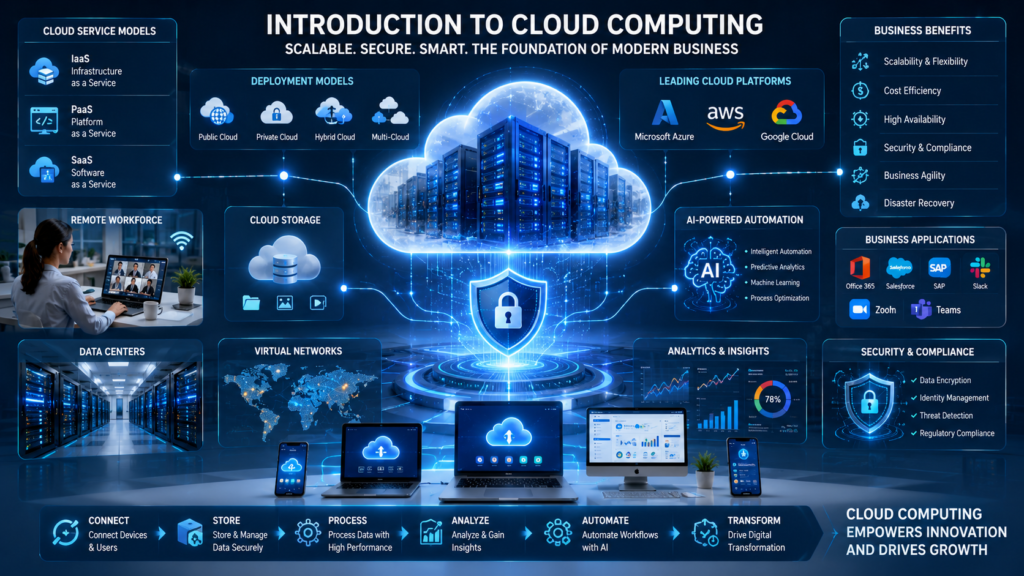
Cloud computing refers to the delivery of computing services over the internet. Instead of relying on local servers or personal devices, organizations can access resources such as storage, databases, networking, software, and computing power through cloud providers.
Cloud computing enables businesses to access technology resources on demand without investing heavily in physical infrastructure.
Key characteristics include:
- On-demand access to computing resources
- Scalability and flexibility
- Cost efficiency
- Remote accessibility
- Automated resource management
Cloud technology allows organizations to focus on innovation while reducing the complexity of managing traditional IT systems.
Why Cloud Computing Matters
Modern businesses operate in an increasingly digital and data-driven environment.
Cloud computing helps organizations:
- Improve operational efficiency
- Reduce infrastructure costs
- Enhance collaboration
- Accelerate application deployment
- Support remote work environments
- Increase business agility
These advantages make cloud computing a key driver of digital transformation across industries.
Cloud Service Models
Cloud services are generally categorized into three primary models.
Infrastructure as a Service (IaaS)
IaaS provides virtualized computing resources over the internet.
Examples include:
- Amazon Web Services (AWS)
https://aws.amazon.com?utm_source=chatgpt.com
- Microsoft Azure
https://azure.microsoft.com?utm_source=chatgpt.com
- Google Cloud Platform (GCP)
https://cloud.google.com?utm_source=chatgpt.com
Organizations can access servers, storage, and networking without maintaining physical hardware.
Platform as a Service (PaaS)
PaaS provides a platform for developing, testing, and deploying applications.
Benefits include:
- Faster application development
- Reduced infrastructure management
- Improved developer productivity
Software as a Service (SaaS)
SaaS delivers software applications through web browsers.
Popular examples include:
- Microsoft 365
- Google Workspace
- Salesforce
Users can access applications without installing or maintaining software locally.
Benefits of Cloud Computing
1. Scalability
Cloud resources can be scaled up or down based on business requirements.
2. Cost Efficiency
Organizations only pay for the resources they use, reducing infrastructure expenses.
3. Improved Collaboration
Cloud platforms enable teams to work together from any location.
4. Enhanced Security
Modern cloud providers offer advanced security controls, encryption, and compliance features.
5. Business Continuity
Cloud-based backup and disaster recovery solutions help organizations maintain operations during disruptions.
Challenges of Cloud Computing
While cloud computing offers numerous advantages, organizations may face certain challenges.
Security Risks
Protecting sensitive data remains a top concern.
Potential risks include:
- Data breaches
- Unauthorized access
- Misconfigured cloud environments
Implementation Complexity
Migrating existing systems to the cloud can require careful planning and technical expertise.
Skill Gaps
Many organizations face shortages of professionals with cloud-related skills and certifications.
Compliance Requirements
Businesses must ensure cloud environments meet industry-specific regulatory standards.
Best Practices for Cloud Adoption
Organizations can maximize cloud success by following key strategies:
Develop a Cloud Strategy
Create a clear roadmap aligned with business objectives.
Prioritize Security
Implement identity management, encryption, and continuous monitoring.
Invest in Training
Develop cloud skills across IT and business teams.
Monitor Performance
Use analytics and monitoring tools to optimize cloud resources.
The Role of AI and Automation in Cloud Computing
Cloud computing increasingly integrates with artificial intelligence and automation technologies.
Examples include:
- AI-powered analytics
- Automated infrastructure management
- Predictive maintenance
- Intelligent security monitoring
These innovations help organizations improve efficiency and accelerate digital transformation initiatives.
Future Trends in Cloud Computing
The future of cloud computing continues to evolve rapidly.
Key trends include:
Hybrid and Multi-Cloud Adoption
Organizations increasingly combine multiple cloud environments to improve flexibility.
AI-Driven Cloud Operations
Artificial intelligence will automate cloud management and optimization.
Edge Computing
Processing data closer to users will reduce latency and improve performance.
Sustainable Cloud Infrastructure
Cloud providers are investing in energy-efficient and environmentally sustainable technologies.
Future Outlook
As businesses become more digital, cloud computing will remain a foundational technology for innovation and growth.
Organizations that embrace cloud technologies early can benefit from:
- Greater agility
- Faster innovation
- Improved customer experiences
- Enhanced competitiveness
Cloud computing will continue to drive transformation across healthcare, finance, manufacturing, retail, and countless other industries.
Conclusion
Cloud computing has transformed how organizations access technology, manage data, and deliver services. Its ability to provide scalability, flexibility, cost efficiency, and innovation makes it a critical component of modern business strategies.
While challenges such as security, implementation complexity, and skill gaps exist, organizations that adopt best practices can successfully leverage cloud technologies to achieve long-term growth.
As AI, automation, and emerging cloud innovations continue to evolve, the future of cloud computing remains incredibly promising.
To learn more about our expertise in cloud technologies, digital transformation, and business innovation, visit our About Us page.
https://morepublicconnect.in/about/
Interested in implementing cloud solutions for your organization? Feel free to Contact Us to learn how we can help.
https://morepublicconnect.in/contact/
Frequently Asked Questions (FAQs)
What is cloud computing?
Cloud computing is the delivery of computing services such as storage, servers, software, and databases over the internet.
What are the main types of cloud services?
The three primary cloud service models are Infrastructure as a Service (IaaS), Platform as a Service (PaaS), and Software as a Service (SaaS).
What are the benefits of cloud computing?
Key benefits include scalability, cost efficiency, improved collaboration, enhanced security, and business continuity.
What challenges does cloud computing present?
Common challenges include security risks, migration complexity, skill shortages, and compliance requirements.
What is the future of cloud computing?
Future trends include AI-powered cloud management, hybrid cloud adoption, edge computing, and sustainable cloud infrastructure.
🚀 Ready to Transform Your Business?
From AI and Agentic AI to Cloud, Data, Automation, and Digital Transformation, KPSmart IT Solutions helps businesses turn technology opportunities into measurable business outcomes.
Have a challenge? Have an idea? Let’s talk.
👉 Explore KPSmart IT Solutions
KPSmart IT Solutions — Build Smart. Automate. Transform. Grow.
#KPSmartITSolutions #AI #ArtificialIntelligence #AgenticAI #DigitalTransformation #BusinessAutomation #EnterpriseAI #Innovation