
Back to: AjitPravas
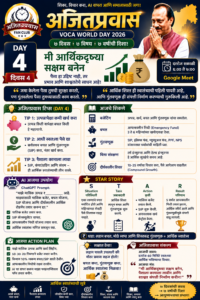
Day 4 – Financial Intelligence & Wealth Creation
Theme
Money Should Work For You
Learning Objectives
- Financial discipline
- Wealth creation
- Investment basics
- Risk management
Modules
- Personal Finance
- Budgeting
- Mutual Funds
- Equity
- Insurance
- Retirement Planning
Frameworks
- Financial Pyramid
- Cash Flow Analysis
- Rule of 72
- Asset Allocation
Case Studies
- Warren Buffett
- Rakesh Jhunjhunwala
Activity
Create Personal Financial Plan
Deliverable
10-Year Wealth Plan
Day 4 – Financial Intelligence & Wealth Creation
Money Should Work for You
“Do not save what is left after spending; instead, spend what is left after saving.” — Warren Buffett
Financial success is not determined by how much money you earn—it is determined by how effectively you manage, invest, and grow it. Many professionals earn high salaries yet struggle financially because they lack financial discipline and long-term planning. Conversely, countless individuals with modest incomes have built substantial wealth through consistent saving, disciplined investing, and informed financial decisions.
Financial intelligence is the ability to understand how money works, make sound financial choices, manage risks, and create sustainable wealth over time. In an era of inflation, economic uncertainty, and increasing life expectancy, financial literacy has become a critical life skill rather than an optional one.
This session is designed to help participants build a strong financial foundation, understand investment options, manage financial risks, and develop a long-term wealth creation strategy.
Why Financial Intelligence Matters
Money affects nearly every aspect of our lives:
-
Education
-
Healthcare
-
Career choices
-
Entrepreneurship
-
Family security
-
Retirement
-
Lifestyle
-
Social contribution
Yet, financial education is often missing from formal schooling.
Many people experience financial stress because they:
-
Spend before saving.
-
Depend on a single income source.
-
Delay investing.
-
Ignore inflation.
-
Lack emergency funds.
-
Underestimate retirement needs.
Financial intelligence empowers individuals to take control of their financial future rather than being controlled by financial circumstances.
Learning Objectives
By the end of this session, participants will be able to:
-
Develop disciplined financial habits.
-
Create and manage personal budgets.
-
Understand wealth creation principles.
-
Evaluate different investment options.
-
Build diversified investment portfolios.
-
Understand insurance and risk management.
-
Plan effectively for retirement.
-
Develop a comprehensive ten-year wealth creation strategy.
Module 1: Personal Finance
What is Personal Finance?
Personal finance is the process of managing your income, expenses, savings, investments, taxes, insurance, and retirement planning to achieve financial stability and long-term goals.
Financial success begins with understanding where your money comes from and where it goes.
The Five Pillars of Personal Finance
-
Income Management
-
Expense Management
-
Saving
-
Investing
-
Protection (Insurance & Emergency Funds)
These pillars work together to build financial resilience.
Good Financial Habits
Successful wealth creators:
-
Spend less than they earn.
-
Save consistently.
-
Invest regularly.
-
Avoid unnecessary debt.
-
Maintain emergency funds.
-
Review finances periodically.
Financial discipline is built through consistent habits rather than occasional large financial decisions.
Module 2: Budgeting
Every Rupee Needs a Purpose
A budget is not a restriction—it is a roadmap for financial freedom.
Budgeting helps you:
-
Track expenses.
-
Control unnecessary spending.
-
Increase savings.
-
Reduce financial stress.
-
Achieve financial goals.
The 50-30-20 Rule
A practical budgeting framework divides monthly income into three categories:
-
50% – Needs: Housing, food, transportation, utilities, education.
-
30% – Wants: Entertainment, travel, dining, hobbies.
-
20% – Savings and Investments: Emergency fund, SIPs, retirement, insurance.
This model can be adjusted based on individual circumstances, but the principle remains: pay yourself first.
Monthly Budget Template
| Category | Percentage | Example |
|---|---|---|
| Income | 100% | Monthly Salary |
| Essentials | 50% | Rent, groceries, utilities |
| Lifestyle | 30% | Shopping, entertainment |
| Investments | 20% | SIPs, retirement savings |
Module 3: Mutual Funds
Investing Made Simple
Mutual funds pool money from many investors and invest it across diversified assets such as equities, bonds, or a combination of both.
Managed by professional fund managers, mutual funds are suitable for investors seeking diversification and long-term growth.
Types of Mutual Funds
-
Equity Funds
-
Debt Funds
-
Hybrid Funds
-
Index Funds
-
ELSS (Tax Saving Funds)
Why SIPs Matter
A Systematic Investment Plan (SIP) allows investors to contribute a fixed amount regularly.
Benefits include:
-
Rupee cost averaging.
-
Investment discipline.
-
Power of compounding.
-
Accessibility for small investors.
Starting early significantly increases long-term wealth due to compounding.
Module 4: Equity Investing
Becoming a Business Owner
When you purchase shares of a company, you become a part-owner of that business.
Equity investments have historically provided strong long-term returns, though they also involve higher short-term volatility.
Factors to Evaluate Before Investing
-
Business model.
-
Revenue growth.
-
Profitability.
-
Competitive advantage.
-
Debt levels.
-
Corporate governance.
-
Management quality.
-
Industry outlook.
Investing should be based on research and long-term fundamentals rather than speculation.
Investment Principles
-
Invest for the long term.
-
Diversify across sectors.
-
Avoid emotional decisions.
-
Stay invested during market fluctuations.
-
Review periodically without reacting to short-term noise.
Module 5: Insurance
Protect Before You Grow
Insurance is not an investment—it is financial protection.
Without adequate protection, years of wealth creation can be lost due to unforeseen events.
Essential Insurance Types
Health Insurance
Protects against rising medical costs.
Life Insurance (Term Insurance)
Provides financial security to dependents in the event of the policyholder’s death.
Motor Insurance
Protects against vehicle-related risks and legal liabilities.
Property Insurance
Safeguards homes and assets against damage or disasters.
Business Insurance
Protects organizations from operational and financial risks.
Building an Emergency Fund
Financial experts recommend maintaining emergency savings equivalent to 6–12 months of essential living expenses. This fund provides a safety net during job loss, medical emergencies, or unexpected financial setbacks.
Module 6: Retirement Planning
Retirement Begins Today
Retirement planning is not about old age—it is about achieving financial independence.
The earlier you begin, the greater the benefit of compounding.
Retirement Planning Process
-
Estimate future expenses.
-
Account for inflation.
-
Determine retirement income requirements.
-
Estimate required investment corpus.
-
Invest consistently.
-
Review the plan annually.
The Power of Compounding
Albert Einstein is often credited with calling compounding one of the greatest forces in finance.
For example, a small monthly investment started in your twenties has decades to grow, often outperforming much larger investments started later in life.
The greatest asset in investing is time.
Financial Intelligence Frameworks
1. Financial Pyramid
The Financial Pyramid helps prioritize financial decisions.
Level 1 – Income
Earn stable income through employment, business, or other legitimate sources.
Level 2 – Emergency Fund
Build adequate reserves before taking investment risks.
Level 3 – Insurance
Protect yourself and your family against unforeseen financial events.
Level 4 – Investments
Grow wealth through diversified investments.
Level 5 – Wealth Creation
Create long-term assets and passive income streams.
The pyramid emphasizes building a solid foundation before pursuing higher-risk opportunities.
2. Cash Flow Analysis
Cash flow analysis tracks the movement of money.
Income
↓
Expenses
↓
Savings
↓
Investments
↓
Net Worth Growth
Positive cash flow enables sustainable wealth creation.
3. Rule of 72
The Rule of 72 estimates how long it takes for an investment to double.
Formula:
Years to Double = 72 ÷ Annual Rate of Return (%)
Example
If your investment earns 12% annually:
72 ÷ 12 = 6 years
Your investment approximately doubles every six years.
This simple rule demonstrates the importance of earning consistent long-term returns.
4. Asset Allocation
Asset allocation is the process of spreading investments across different asset classes to balance risk and return.
Common asset classes include:
-
Equity
-
Debt
-
Gold
-
Real Estate
-
Cash and Liquid Funds
The appropriate allocation depends on age, goals, risk tolerance, and investment horizon.
Diversification helps reduce the impact of market volatility.
Case Studies
Warren Buffett – The Power of Patience
Warren Buffett, often called the “Oracle of Omaha,” built one of the world’s largest fortunes through disciplined investing, patience, and value investing. Rather than chasing short-term market trends, he focused on businesses with strong fundamentals, capable management, and sustainable competitive advantages.
His philosophy emphasizes:
-
Invest in businesses you understand.
-
Think long term.
-
Avoid emotional investing.
-
Let compounding work over decades.
Financial Lesson: Wealth is created through consistency, patience, and disciplined decision-making rather than frequent trading.
Rakesh Jhunjhunwala – Conviction and Long-Term Vision
Known as the “Big Bull of India,” Rakesh Jhunjhunwala demonstrated how conviction, research, and long-term investing can create significant wealth. He invested in companies with strong growth potential and remained invested despite market fluctuations.
His investment philosophy included:
-
Thorough research.
-
Belief in India’s long-term growth.
-
Diversification.
-
Learning from mistakes.
-
Maintaining patience during market volatility.
Financial Lesson: Successful investing requires knowledge, discipline, and the courage to remain committed to sound investments.
Activity: Create Your Personal Financial Plan
Participants will prepare a practical financial plan tailored to their current circumstances and future aspirations.
Step 1 – Assess Current Financial Position
List:
-
Monthly income
-
Fixed expenses
-
Variable expenses
-
Existing savings
-
Current investments
-
Outstanding debts
Step 2 – Define Financial Goals
Examples include:
-
Emergency fund
-
Home purchase
-
Children’s education
-
Business startup
-
Retirement
-
International travel
Step 3 – Build a Budget
Create a realistic monthly budget that prioritizes savings and investments while managing essential and discretionary expenses.
Step 4 – Create an Investment Strategy
Determine:
-
Monthly investment amount.
-
Preferred investment options.
-
Asset allocation.
-
Investment horizon.
Step 5 – Review Risk Protection
Evaluate:
-
Health insurance coverage.
-
Life insurance needs.
-
Emergency fund adequacy.
-
Existing financial risks.
Step 6 – Establish Review Milestones
Monitor financial progress every quarter and review the overall plan annually.
Deliverable: 10-Year Wealth Plan
Each participant will develop a comprehensive wealth creation roadmap that includes:
-
Current Financial Snapshot
-
Net Worth Statement
-
Income and Expense Analysis
-
Budget Strategy
-
Emergency Fund Plan
-
Debt Reduction Strategy
-
Insurance Review
-
Investment Portfolio Allocation
-
Retirement Savings Roadmap
-
Ten-Year Financial Goals
-
Annual Investment Milestones
-
Expected Net Worth Targets
-
Risk Management Strategy
-
Annual Review and Rebalancing Schedule
Key Takeaways
By the end of Day 4, participants will:
-
Understand the principles of personal financial management.
-
Develop disciplined budgeting and saving habits.
-
Build diversified investment portfolios aligned with long-term goals.
-
Apply proven financial frameworks such as the Financial Pyramid, Cash Flow Analysis, the Rule of 72, and Asset Allocation.
-
Recognize the importance of insurance and emergency preparedness.
-
Plan confidently for retirement and long-term financial independence.
-
Create a practical, measurable 10-year wealth plan.
“Financial freedom is not achieved by earning more alone. It is built through disciplined spending, consistent investing, prudent risk management, and the patience to let compounding work over time. When your money begins to work for you, you gain the freedom to focus on what truly matters—your family, your aspirations, and your contribution to society.”