
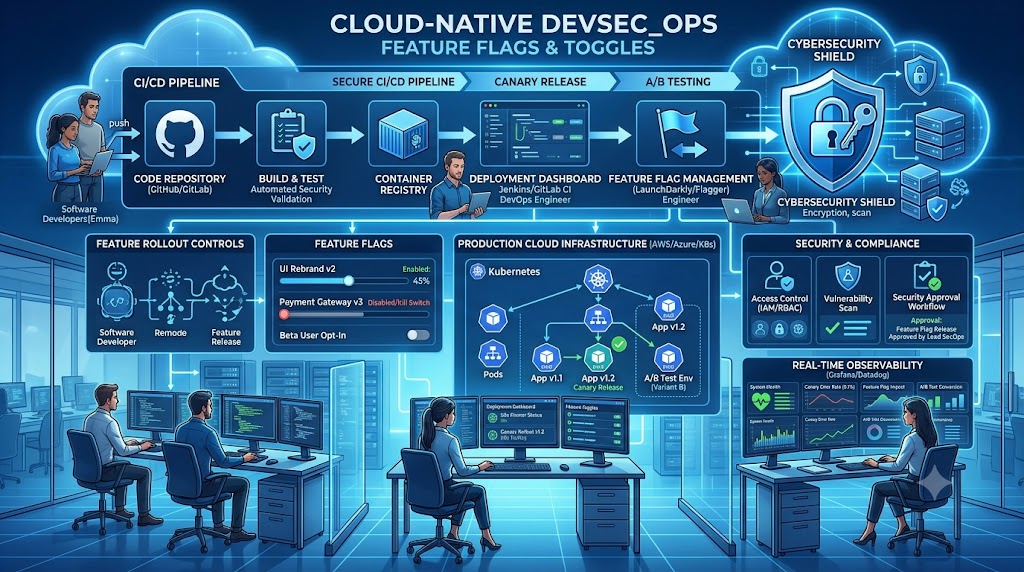
Security-first feature flags and feature toggles are becoming an essential component of modern cloud-native DevOps environments. As organizations strive to accelerate software delivery while maintaining strong security standards, feature flags provide a powerful mechanism for controlling how and when new functionality is exposed to users. By separating deployment from release, teams can introduce features into production environments without immediately making them available to all users. This approach reduces deployment risks, supports continuous delivery, and enables organizations to validate functionality, performance, and security before a full-scale rollout.
Cloud-native applications are often built using microservices, containers, APIs, and distributed infrastructure that operate across multiple environments. Managing feature releases in such complex ecosystems requires careful planning and governance. Feature flags allow development teams to enable, disable, or modify functionality instantly without requiring additional code deployments. While this flexibility improves agility, poorly managed feature flags can introduce security vulnerabilities, expose sensitive functionality, or create compliance challenges. Security-first feature management helps organizations address these risks by treating feature flags as critical security controls rather than simple release mechanisms.
A security-focused approach begins with establishing clear ownership, governance, and accountability. Every feature flag should have a defined purpose, target audience, lifecycle, and approval process. Flags controlling authentication systems, authorization policies, administrative privileges, debugging functions, or sensitive data access should be classified according to risk levels and monitored closely. Assigning ownership ensures that security-sensitive configurations remain under proper control and that changes are reviewed before implementation.
Automation plays a critical role in strengthening feature flag security. Modern CI/CD pipelines can automatically validate feature configurations, enforce security policies, and verify that high-risk changes pass security testing before deployment. Automated approval workflows, code scanning, and compliance checks help reduce human error while ensuring that feature releases align with organizational security requirements. Regular reviews and automated cleanup processes can also remove obsolete feature flags, reducing technical debt and minimizing unnecessary attack surfaces.
Observability and continuous monitoring further enhance the effectiveness of security-first feature management. Organizations can use real-time dashboards and analytics platforms to understand how feature flags influence application behavior across environments. Security teams gain visibility into configuration changes, unusual activity patterns, and unexpected access events. If a feature introduces security concerns, performance degradation, or operational disruptions, teams can quickly disable the functionality without performing a complete application rollback. This capability supports safer experimentation through canary releases, phased deployments, and A/B testing while maintaining strong operational control.
As cloud-native development continues to evolve, feature flags and feature toggles are becoming strategic tools for balancing innovation with security. Organizations that integrate security-first feature management into their DevSecOps practices can accelerate software delivery, improve deployment reliability, reduce operational risks, and strengthen application security. By combining governance, automation, monitoring, and risk-based controls, businesses can confidently release new capabilities while protecting critical systems, sensitive data, and user trust in increasingly dynamic cloud environments.
🚀 Ready to Transform Your Business?
From AI and Agentic AI to Cloud, Data, Automation, and Digital Transformation, KPSmart IT Solutions helps businesses turn technology opportunities into measurable business outcomes.
Have a challenge? Have an idea? Let’s talk.
👉 Explore KPSmart IT Solutions
KPSmart IT Solutions — Build Smart. Automate. Transform. Grow.
#KPSmartITSolutions #AI #ArtificialIntelligence #AgenticAI #DigitalTransformation #BusinessAutomation #EnterpriseAI #Innovation