
Introduction
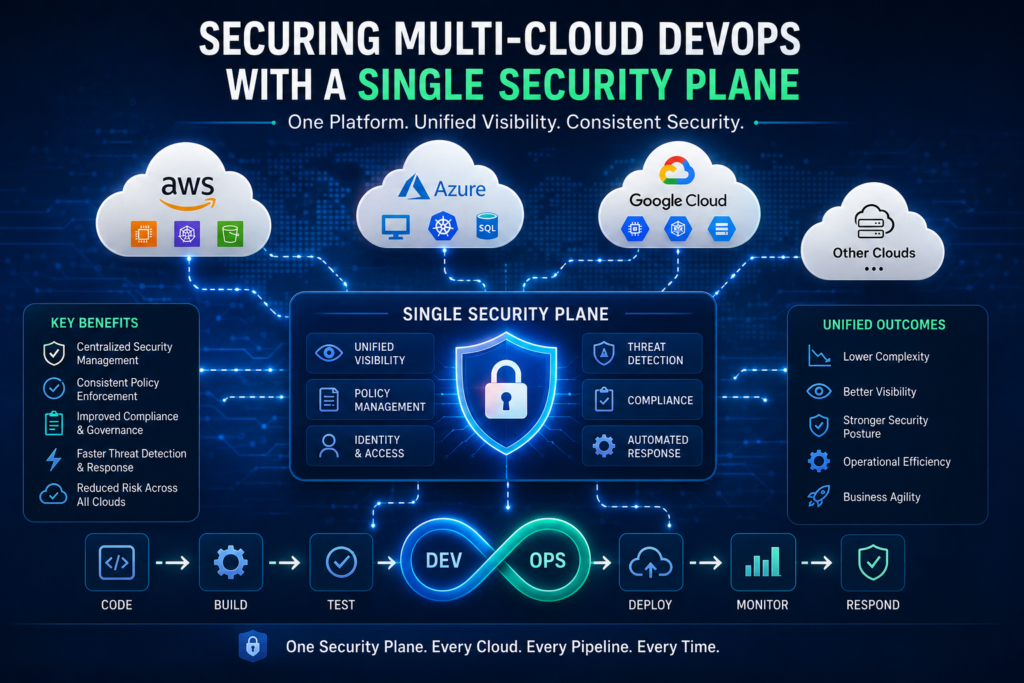
Securing Multi-Cloud DevOps with a Single Security Plane has become a strategic priority for organizations operating across multiple cloud platforms. As businesses adopt services from AWS, Azure, Google Cloud, and other providers, managing security consistently across environments becomes increasingly challenging. Consequently, security teams often struggle with fragmented visibility, inconsistent policies, and compliance risks.
A single security plane helps organizations centralize security management across cloud environments. Therefore, businesses can improve visibility, automate security controls, and strengthen compliance while maintaining the flexibility of a multi-cloud strategy. As cloud adoption continues to accelerate, Securing Multi-Cloud DevOps with a Single Security Plane is becoming essential for modern cybersecurity operations .Furthermore, organizations should follow security recommendations published by OWASP and CISA to strengthen multi-cloud DevOps security and maintain compliance across cloud environments.
What Is a Single Security Plane?
A single security plane is a centralized security framework that provides unified visibility, monitoring, policy enforcement, and threat management across multiple cloud environments. Instead of managing separate security tools for each cloud provider, organizations use a common security layer to monitor and secure all environments.
Key capabilities include:
- Centralized security monitoring
- Unified policy enforcement
- Compliance management
- Identity and access control
- Threat detection and response
- Risk assessment and reporting
As a result, security teams can manage complex cloud infrastructures more efficiently.
Why Multi-Cloud Security Is Challenging
Multi-cloud environments provide flexibility and resilience. However, they also introduce significant security challenges.
Inconsistent Security Policies
Different cloud providers offer unique security models and configurations. Consequently, organizations may struggle to maintain consistent security standards across environments.
Limited Visibility
Security teams often use separate tools for each cloud platform. Therefore, gaining a complete view of security risks becomes difficult.
Compliance Complexity
Organizations must meet regulatory requirements across multiple systems and jurisdictions. Furthermore, tracking compliance manually can be time-consuming and error-prone.
Increased Attack Surface
Every cloud environment introduces additional resources, applications, APIs, and user accounts. As a result, attackers have more opportunities to exploit vulnerabilities.
Benefits of Securing Multi-Cloud DevOps with a Single Security Plane
Unified Visibility
A centralized security platform provides real-time visibility across all cloud environments.
Benefits include:
- Faster threat detection
- Improved monitoring
- Better incident response
- Reduced blind spots
Therefore, organizations can identify risks before they become serious security incidents.
Consistent Security Policies
A single security plane enables organizations to enforce standardized security controls across cloud platforms.
This helps:
- Reduce configuration errors
- Strengthen governance
- Improve security consistency
- Simplify management
Improved Compliance Management
Compliance requirements continue to evolve. However, a centralized security platform simplifies compliance monitoring and reporting.
Organizations can:
- Automate compliance checks
- Generate audit reports
- Monitor policy violations
- Maintain regulatory readiness
Faster Incident Response
When security incidents occur, centralized visibility allows teams to investigate and respond more efficiently.
Consequently, businesses can minimize operational disruptions and reduce potential damage.
Key Components of a Single Security Plane
Identity and Access Management
Identity security remains one of the most important aspects of cloud security.
Best practices include:
- Multi-factor authentication
- Role-based access control
- Least-privilege access
- Continuous identity monitoring
Furthermore, centralized identity management reduces unauthorized access risks.
Security Information and Event Management
SIEM platforms collect and analyze security data from multiple cloud environments.
Advantages include:
- Centralized log management
- Real-time threat detection
- Security analytics
- Incident investigation
Cloud Security Posture Management
Cloud Security Posture Management continuously monitors cloud configurations and identifies security risks.
Organizations can:
- Detect misconfigurations
- Monitor compliance
- Assess vulnerabilities
- Improve cloud security posture
Additionally, CSPM tools help automate security assessments across cloud platforms.
Automated Threat Detection
Modern security platforms use artificial intelligence and machine learning to identify suspicious activities.
As a result, security teams can detect threats faster and reduce manual workloads.
Best Practices for Securing Multi-Cloud DevOps with a Single Security Plane
Adopt Zero Trust Security
Zero Trust assumes that no user or device should be trusted automatically.
Organizations should:
- Verify identities continuously
- Enforce least-privilege access
- Monitor user behavior
- Secure cloud workloads
Therefore, Zero Trust significantly improves security resilience.
Implement Security as Code
Security policies should be integrated directly into development workflows.
Benefits include:
- Consistent enforcement
- Faster deployments
- Automated compliance
- Reduced human error
Moreover, Security as Code supports scalable cloud-native security operations.
Secure CI/CD Pipelines
CI/CD pipelines play a critical role in modern DevOps environments.
Organizations should:
- Protect build systems
- Scan source code
- Validate configurations
- Monitor deployment activities
Consequently, software can be delivered securely without slowing development.
Enable Continuous Monitoring
Continuous monitoring provides ongoing visibility into cloud resources and activities.
This helps organizations:
- Detect threats quickly
- Monitor policy compliance
- Identify anomalies
- Reduce security risks
Emerging Trends in Multi-Cloud Security
AI-Powered Security Operations
Artificial intelligence is improving threat detection and incident response capabilities across multi-cloud environments.
Unified Security Platforms
Organizations are increasingly adopting integrated security solutions that provide centralized visibility and management.
Automated Compliance Monitoring
Compliance automation reduces manual effort while improving regulatory readiness.
Cloud-Native Security Integration
Security is becoming deeply integrated into cloud-native architectures, enabling proactive risk management.
Future Outlook
As organizations continue expanding their cloud footprints, managing security across multiple environments will become even more important. Therefore, centralized security strategies will play a crucial role in protecting applications, infrastructure, and sensitive data.
Businesses that invest in Securing Multi-Cloud DevOps with a Single Security Plane will gain stronger visibility, improved compliance, and better protection against evolving cyber threats. Furthermore, unified security management will enable organizations to scale cloud operations confidently while maintaining a robust security posture.
Conclusion
Securing Multi-Cloud DevOps with a Single Security Plane helps organizations simplify security management, improve visibility, and strengthen compliance across diverse cloud environments. By implementing centralized security controls, continuous monitoring, Zero Trust principles, and automated threat detection, businesses can reduce risks while supporting innovation.
Ultimately, organizations that adopt a unified security strategy will be better positioned to secure their multi-cloud environments and achieve long-term operational resilience.
Frequently Asked Questions
What is a single security plane?
A single security plane is a centralized platform that manages security policies, monitoring, compliance, and threat detection across multiple cloud environments.
Why is multi-cloud security difficult?
Multi-cloud environments involve different security models, configurations, and tools, making consistent security management challenging.
How does a single security plane improve security?
It provides centralized visibility, consistent policy enforcement, automated compliance monitoring, and faster threat detection.
What role does Zero Trust play in multi-cloud security?
Zero Trust continuously verifies users and devices, reducing unauthorized access and strengthening cloud security.
How can organizations secure multi-cloud DevOps environments?
Organizations should implement centralized security management, continuous monitoring, Security as Code, Zero Trust principles, and automated threat detection.
🚀 Ready to Transform Your Business?
From AI and Agentic AI to Cloud, Data, Automation, and Digital Transformation, KPSmart IT Solutions helps businesses turn technology opportunities into measurable business outcomes.
Have a challenge? Have an idea? Let’s talk.
👉 Explore KPSmart IT Solutions
KPSmart IT Solutions — Build Smart. Automate. Transform. Grow.
#KPSmartITSolutions #AI #ArtificialIntelligence #AgenticAI #DigitalTransformation #BusinessAutomation #EnterpriseAI #Innovation