Uncategorized

Continuous Security Posture Management for Cloud‑Native DevOps

Introduction Continuous Security Posture Management for Cloud-Native DevOps has become essential as organizations increasingly adopt cloud-native technologies. Modern applications rely on containers, Kubernetes, microservices, APIs, and automated CI/CD pipelines. While these technologies improve agility and scalability, they also introduce new security challenges that require continuous monitoring and management. Continuous Security Posture Management for Cloud-Native DevOps […]

Continuous Security Posture Management for Cloud‑Native DevOps Read More »

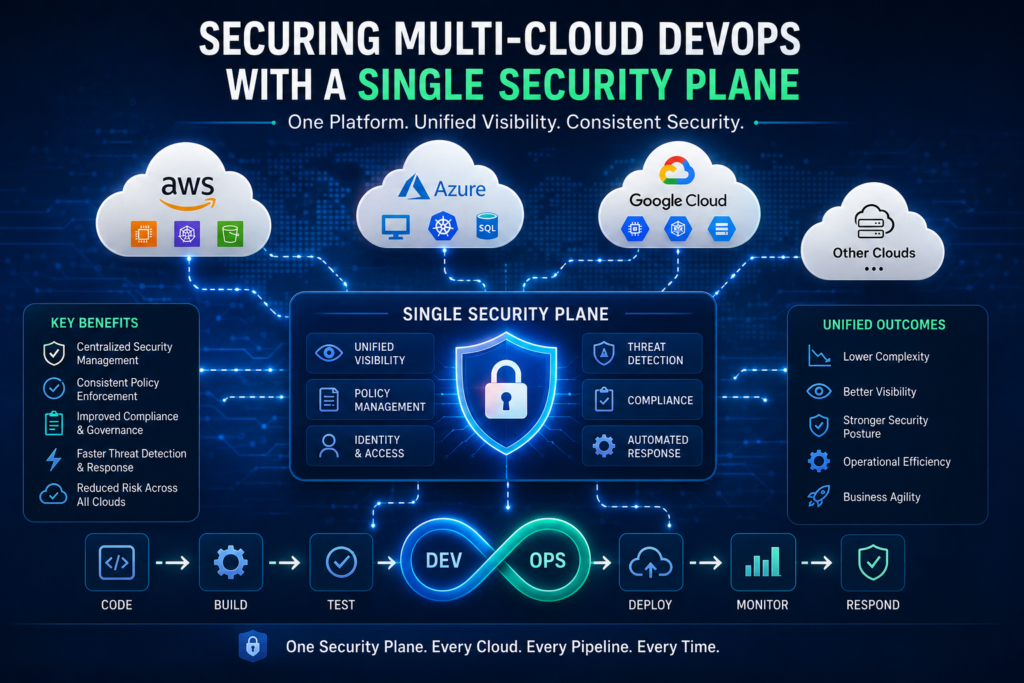
Securing Multi‑Cloud DevOps with a Single Security Plane

Introduction Securing Multi-Cloud DevOps with a Single Security Plane has become a strategic priority for organizations operating across multiple cloud platforms. As businesses adopt services from AWS, Azure, Google Cloud, and other providers, managing security consistently across environments becomes increasingly challenging. Consequently, security teams often struggle with fragmented visibility, inconsistent policies, and compliance risks. A

Securing Multi‑Cloud DevOps with a Single Security Plane Read More »

Shifting Security Left: Integrating Security into Cloud‑Native DevOps Pipelines

Blog Body In cloud‑native DevOps, security can no longer be a final “gate” at the end of a long delivery pipeline; instead, it must be embedded from the very first commit. Shifting security left means running automated security checks—SAST, DAST, container scanning, secrets detection, and policy‑as‑code validation—inside every pull request and CI job so that

Shifting Security Left: Integrating Security into Cloud‑Native DevOps Pipelines Read More »

Securing Open‑Source Dependencies in Cloud‑Native DevOps

Cloud‑native DevOps pipelines heavily rely on open‑source libraries, frameworks, and container images, making dependency security one of the most critical yet often overlooked layers. Vulnerable or malicious packages can slip into builds through transitive dependencies, supply‑chain attacks, or outdated base images, allowing attackers to exploit them long after deployment. To mitigate this, organisations integrate Software

Securing Open‑Source Dependencies in Cloud‑Native DevOps Read More »

Runtime Security for Cloud‑Native DevOps Workloads

As cloud‑native DevOps shifts more logic into containers, serverless functions, and microservices, traditional perimeter‑based security becomes insufficient. Runtime security focuses on protecting workloads while they are actually running, detecting and blocking malicious behaviour such as unauthorised process execution, unexpected network connections, or suspicious file‑system changes. Security agents embedded in pods, nodes, or cloud‑runtime environments continuously

Runtime Security for Cloud‑Native DevOps Workloads Read More »

Cloud‑Native DevOps Security Best Practices 2026

Securing cloud‑native DevOps in 2026 means moving beyond point‑in‑time scans and manual gates to a continuous, automated security model across cloud, clusters, containers, and code. Key practices include embedding security early in the pipeline (shift‑left), standardising identity and least‑privilege access, and continuously scanning dependencies, infrastructure‑as‑code, and runtime behaviour. Teams treat security as shared ownership: developers

Cloud‑Native DevOps Security Best Practices 2026 Read More »

scaling Security Culture in Cloud‑Native DevOps Teams

Cloud‑native DevOps is only as secure as the collective habits and incentives of the teams that build and operate it. Scaling security culture means moving beyond a small “security team” doing isolated audits to a model where every engineer, SRE, and product owner feels responsible for security outcomes. This is achieved by embedding security visibility—metrics,

scaling Security Culture in Cloud‑Native DevOps Teams Read More »

Zero‑Trust Secrets Management for Cloud‑Native Environments

In a zero‑trust world, credentials are never assumed to be safe, even inside a trusted network or cloud account. Secrets management in cloud‑native environments must therefore enforce strong identity‑based access, short‑lived tokens, and continuous verification at every interaction. Instead of granting broad, static credentials to services, each workload receives narrowly scoped secrets tied to its

Zero‑Trust Secrets Management for Cloud‑Native Environments Read More »

Automated Secrets Rotation and Revocation in CI/CD

In cloud‑native CI/CD, manually rotating secrets after a suspected incident or team change is too slow and error‑prone. Automated secrets rotation and revocation workflows ensure that every credential has a known lifetime, after which it is automatically refreshed or invalidated without requiring human intervention. CI/CD pipelines can trigger rotation on deployment, on a schedule, or

Automated Secrets Rotation and Revocation in CI/CD Read More »

Scroll to Top

SPIN TO WIN!

  • Try your lucky to get discount coupon
  • 1 spin per email
  • No cheating
Try Your Lucky
Never
Remind later
No thanks