
Introduction
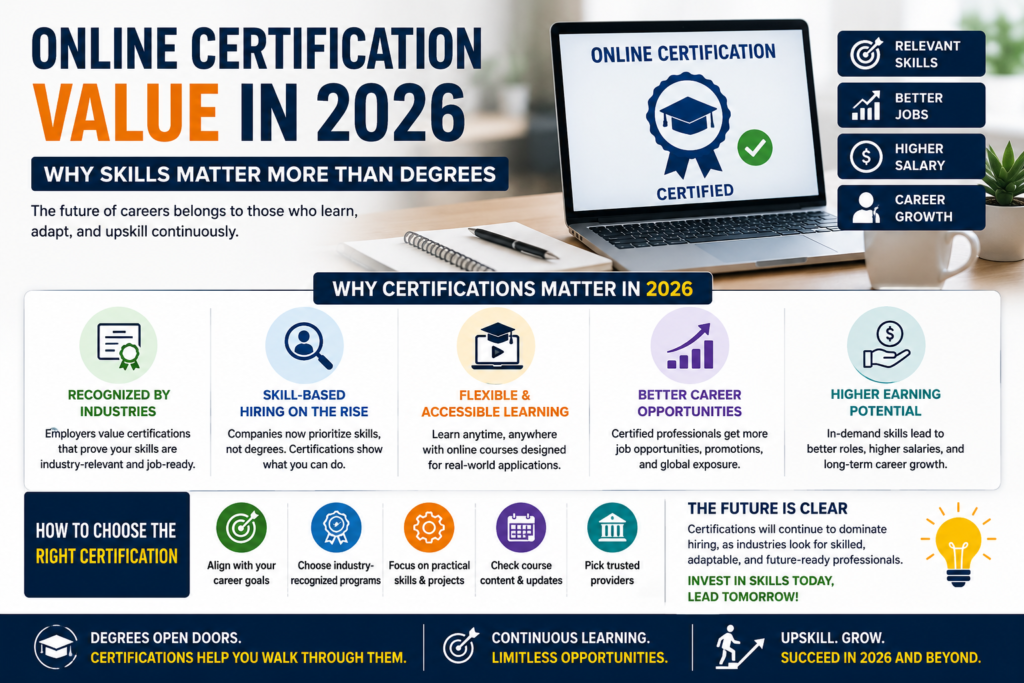
The job market is evolving rapidly, and employers are increasingly prioritizing practical skills over traditional qualifications. While college degrees still hold value, online certifications have emerged as powerful tools for career growth, skill development, and professional advancement. In 2026, certifications are becoming more important than ever as organizations focus on hiring candidates who can demonstrate real-world expertise and job-ready capabilities.
With the rise of digital transformation, remote work, and emerging technologies, professionals are turning to online certifications to stay competitive and relevant in a constantly changing employment landscape.
Why Traditional Degrees Are No Longer Enough
For decades, degrees were considered the primary requirement for securing a good job. However, many employers now recognize that academic education often focuses heavily on theory while providing limited exposure to practical industry applications.
Some common challenges associated with traditional degrees include:
- Outdated curriculum in fast-changing industries
- Limited hands-on experience
- High educational costs
- Long completion timelines
- Lack of specialized technical skills
As industries continue to evolve, businesses are seeking professionals who can immediately contribute to organizational goals without extensive training periods.
The Growing Importance of Online Certifications
Online certifications offer focused, skill-based learning that aligns closely with current industry requirements. These programs are designed to help learners acquire practical knowledge and demonstrate competency in specific fields.
Certifications are particularly valuable because they:
- Validate professional skills
- Enhance employability
- Improve career advancement opportunities
- Support continuous learning
- Demonstrate commitment to professional development
Many certifications are developed in partnership with industry leaders, ensuring that learners gain relevant and up-to-date knowledge.
Industry-Recognized Certifications Driving Career Growth
Several industries now actively value certifications during recruitment and promotion decisions. Some of the most sought-after certification categories include:
Information Technology
Certifications in cloud computing, cybersecurity, networking, and software development continue to experience strong demand.
Data Analytics and Artificial Intelligence
As businesses increasingly rely on data-driven decision-making, certifications in data science, machine learning, and AI are becoming highly valuable.
Digital Marketing
SEO, content marketing, social media management, and performance marketing certifications help professionals stand out in competitive digital environments.
Project Management
Project management certifications demonstrate leadership, organizational, and execution capabilities that employers highly value.
Finance and Business Analytics
Certifications in financial analysis, business intelligence, and risk management provide specialized expertise for growing industries.
Skill-Based Hiring Trends in 2026
One of the biggest workplace shifts in 2026 is the rise of skill-based hiring. Organizations are focusing less on educational pedigree and more on demonstrated competencies.
Companies are increasingly evaluating candidates based on:
- Technical skills
- Industry certifications
- Portfolio projects
- Practical assessments
- Problem-solving abilities
- Professional experience
This approach allows employers to identify candidates who can perform effectively from day one, regardless of their academic background.
How to Choose the Right Certification
Not all certifications offer the same value. Professionals should carefully evaluate certification programs before investing their time and money.
Consider the following factors:
Industry Recognition
Choose certifications that are widely respected and recognized by employers.
Career Relevance
Select programs that align with your career goals and target industry.
Practical Learning Opportunities
Focus on certifications that include projects, case studies, and hands-on exercises.
Updated Curriculum
Ensure the content reflects current industry standards and technologies.
Certification Provider Reputation
Choose trusted institutions, organizations, or technology companies with strong industry credibility.
Focus on Practical Learning
The true value of a certification lies in the ability to apply learned concepts in real-world situations. Practical learning helps professionals develop confidence and competence while building a portfolio of work that demonstrates their capabilities.
Professionals should complement certifications with:
- Personal projects
- Internships
- Freelance work
- Industry case studies
- Portfolio development
Combining certification knowledge with practical experience creates a stronger professional profile.
The Future of Certifications
As technology continues to transform industries, certifications are expected to play an even greater role in workforce development. Employers increasingly recognize that continuous learning is essential in a rapidly changing business environment.
Future trends include:
- AI-powered learning platforms
- Micro-credentials and digital badges
- Industry-specific certification pathways
- Personalized learning journeys
- Employer-sponsored certification programs
These developments will make skill acquisition more accessible, flexible, and relevant than ever before.
Conclusion
The value of online certifications in 2026 extends far beyond earning a digital credential. Certifications provide practical skills, industry recognition, and career advancement opportunities that align closely with modern workforce demands.
While degrees remain important for many professions, skills are increasingly becoming the primary currency in today’s job market. Individuals who invest in continuous learning, practical experience, and industry-recognized certifications will be better positioned to succeed in an increasingly competitive and technology-driven world.
Action Step
Identify the most relevant certification in your industry and begin building practical skills that align with future job market demands. Continuous learning today can create significant career opportunities tomorrow.
🚀 Ready to Transform Your Business?
From AI and Agentic AI to Cloud, Data, Automation, and Digital Transformation, KPSmart IT Solutions helps businesses turn technology opportunities into measurable business outcomes.
Have a challenge? Have an idea? Let’s talk.
👉 Explore KPSmart IT Solutions
KPSmart IT Solutions — Build Smart. Automate. Transform. Grow.
#KPSmartITSolutions #AI #ArtificialIntelligence #AgenticAI #DigitalTransformation #BusinessAutomation #EnterpriseAI #Innovation