
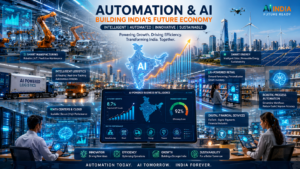
Introduction: The Economic Engine Is Changing
The global economy is undergoing a fundamental transformation. Traditional growth drivers such as manual processes, labor-intensive operations, and conventional business models are rapidly being replaced by intelligent systems powered by Artificial Intelligence (AI), automation, and data-driven decision-making.
https://www.ibm.com/topics/artificial-intelligence?utm_source=chatgpt.com
Across industries, organizations are leveraging advanced technologies to improve efficiency, reduce costs, and unlock new opportunities for growth. AI and automation are no longer limited to large technology companies. They are becoming essential tools for businesses of all sizes seeking to remain competitive in an increasingly digital world.
For India, this transformation presents a unique opportunity. As one of the world’s fastest-growing economies, India has the potential to become a global leader in intelligent innovation by embracing automation and AI-driven development.
Why Automation and AI Matter for India’s Economy
India’s economic growth depends on its ability to improve productivity, enhance operational efficiency, and accelerate innovation across industries.
However, several challenges continue to affect growth:
- High operational inefficiencies
- Labor-intensive processes
- Limited productivity in key sectors
- Rising operational costs
- Increasing global competition
Automation and AI provide solutions that enable businesses and industries to overcome these challenges while creating scalable and sustainable growth models.
By integrating intelligent technologies into daily operations, organizations can achieve faster decision-making, better resource utilization, and improved customer experiences.
Understanding Automation and Artificial Intelligence
What Is Automation?
Automation refers to the use of technology to perform tasks with minimal human intervention. Automated systems can handle repetitive processes, improve consistency, and reduce operational costs.
Examples include:
- Robotic Process Automation (RPA)
- Automated manufacturing systems
- Warehouse automation
- Smart logistics solutions
What Is Artificial Intelligence?
Artificial Intelligence enables machines and software systems to simulate human intelligence by learning from data, recognizing patterns, and making informed decisions.
Common AI applications include:
- Predictive analytics
- Machine learning
- Natural language processing
- Computer vision
- Intelligent automation
Together, automation and AI create powerful systems capable of transforming entire industries.
Industry Insights: AI and Automation in Action
Logistics
The logistics sector is experiencing significant transformation through automation technologies.
Benefits include:
- Faster deliveries
- Optimized route planning
- Reduced transportation costs
- Improved warehouse efficiency
AI-powered logistics systems help businesses streamline operations while enhancing customer satisfaction.
Retail
Retail businesses increasingly use AI to improve customer experiences and optimize operations.
Applications include:
- Demand forecasting
- Inventory optimization
- Personalized recommendations
- Customer behavior analysis
These technologies help retailers increase sales while reducing waste and operational costs.
Energy
The energy sector is adopting smart technologies to improve sustainability and efficiency.
Examples include:
- Smart grids
- Predictive maintenance
- Energy consumption analytics
- Renewable energy optimization
AI-driven energy management systems enable more efficient and sustainable resource utilization.
Manufacturing
Modern manufacturing facilities are embracing Industry 4.0 technologies.
Benefits include:
- Predictive maintenance
- Smart production systems
- Quality control automation
- Increased operational efficiency
Automation allows manufacturers to improve productivity while maintaining consistent quality standards.
Strategic Recommendations for Businesses
1. Automate Repetitive Workflows
Businesses should identify routine tasks that consume significant time and resources.
Examples include:
- Data entry
- Invoice processing
- Customer support queries
- Administrative workflows
Automation enables employees to focus on higher-value activities.
2. Integrate AI into Supply Chains
AI-powered supply chains improve visibility, forecasting accuracy, and operational efficiency.
https://www.mckinsey.com/capabilities/operations/our-insights/supply-chain?utm_source=chatgpt.com
Benefits include:
- Better inventory management
- Reduced supply chain disruptions
- Improved demand forecasting
- Faster decision-making
3. Adopt Data-Driven Decision Making
Data has become one of the most valuable assets in the modern economy.
Organizations should leverage:
- Business intelligence tools
- Predictive analytics
- Performance dashboards
- Real-time reporting systems
These tools enable leaders to make informed strategic decisions.
4. Focus on Cost and Intelligence Optimization
The goal of digital transformation is not only cost reduction but also intelligent growth.
Businesses should balance:
- Operational efficiency
- Innovation
- Customer experience
- Long-term scalability
This approach creates sustainable competitive advantages.
The Role of AI in India’s Economic Growth
Artificial Intelligence is expected to play a significant role in India’s future economic development.
Potential impacts include:
- Increased productivity across industries
- Improved public services
- Enhanced healthcare delivery
- Smarter transportation systems
- Financial inclusion through digital services
- Growth of technology-driven startups
As AI adoption expands, new opportunities will emerge for innovation, entrepreneurship, and employment.
Future Outlook: India’s Intelligent Economy
Over the next decade, automation and AI are expected to become fundamental components of India’s economic infrastructure.
Key trends include:
- AI contributing significantly to GDP growth
- Expansion of intelligent enterprises
- Growth of smart cities
- Increased automation across industries
- Data becoming a critical economic asset
- Greater adoption of AI-powered decision-making
Organizations that embrace these technologies early will be better positioned to compete in the future economy.
Benefits of Automation and AI Adoption
Businesses that invest in automation and AI can achieve:
- Higher productivity
- Lower operational costs
- Faster decision-making
- Improved customer experiences
- Better resource utilization
- Enhanced competitiveness
- Greater scalability
These benefits contribute directly to long-term business growth and economic development.
Conclusion
Automation and Artificial Intelligence are no longer future concepts—they are shaping today’s economy and defining tomorrow’s opportunities.
For India, the adoption of intelligent technologies represents a pathway toward sustainable economic growth, improved productivity, and global competitiveness. Organizations that embrace AI and automation can unlock new efficiencies, drive innovation, and create lasting value.
India’s future economy will be automated, intelligent, data-driven, and highly scalable.
To learn more about our expertise in digital transformation, AI innovation, and future-ready business solutions, visit our About Us page.
https://morepublicconnect.in/about/
Interested in leveraging AI and automation for business growth? Feel free to Contact Us to learn how we can help.
https://morepublicconnect.in/contact/
Frequently Asked Questions (FAQs)
What is the difference between AI and automation?
Automation performs predefined tasks automatically, while AI enables systems to learn, analyze data, and make decisions intelligently.
How can AI improve business productivity?
AI improves productivity by automating repetitive tasks, optimizing workflows, analyzing data, and supporting faster decision-making.
Which industries benefit most from automation?
Manufacturing, logistics, healthcare, retail, finance, and energy sectors benefit significantly from automation technologies.
Why is AI important for India’s economy?
AI can improve productivity, support innovation, enhance public services, and contribute significantly to economic growth.
What is the future of automation in India?
Automation is expected to expand across industries, enabling businesses to improve efficiency, reduce costs, and remain competitive in the global market.
🚀 Ready to Transform Your Business?
From AI and Agentic AI to Cloud, Data, Automation, and Digital Transformation, KPSmart IT Solutions helps businesses turn technology opportunities into measurable business outcomes.
Have a challenge? Have an idea? Let’s talk.
👉 Explore KPSmart IT Solutions
KPSmart IT Solutions — Build Smart. Automate. Transform. Grow.
#KPSmartITSolutions #AI #ArtificialIntelligence #AgenticAI #DigitalTransformation #BusinessAutomation #EnterpriseAI #Innovation