
Introduction: The Evolution of Digital Payments
Digital payments have become an essential part of modern life. From online shopping and food delivery to subscription services and utility bill payments, consumers increasingly rely on digital platforms for fast and convenient transactions.
As digital payment adoption grows, so do concerns surrounding payment security, fraud prevention, and data privacy. One of the biggest challenges has been the storage of card information across multiple websites and applications, creating potential risks for consumers and businesses alike.
To address these concerns, the financial industry has embraced tokenisation and digital wallets as key technologies that enhance security while maintaining a seamless user experience.
Today, tokenisation and digital wallets are transforming how card-on-file payments work, creating a safer and more efficient digital payment ecosystem.
What Is Tokenisation?
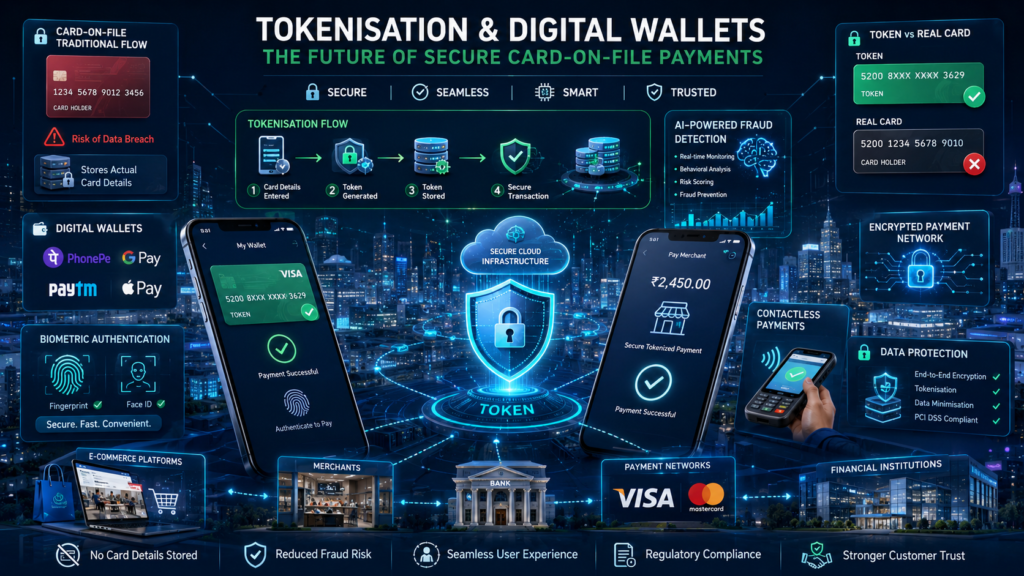
Tokenisation is a security process that replaces sensitive card information with a unique digital identifier known as a token.
Instead of storing an actual debit or credit card number, merchants store a randomly generated token that has no exploitable value outside the specific payment environment.
Key characteristics of tokenisation include:
- Sensitive card data remains protected
- Tokens cannot be reverse-engineered
- Reduced risk of data breaches
- Enhanced payment security
- Improved customer trust
Even if attackers gain access to a token, they cannot use it to retrieve the original card information or perform unauthorized transactions.
How Tokenisation Works
The tokenisation process follows a secure workflow:
Step 1: Card Registration
A customer enters their card information while making an online purchase or saving payment details.
Step 2: Token Generation
The payment network replaces the card number with a unique token.
Step 3: Secure Storage
The merchant stores the token instead of the actual card details.
Step 4: Transaction Processing
Whenever a payment is initiated, the token is used to authorize the transaction.
Step 5: Verification and Approval
The issuing bank verifies the token and approves the payment securely.
This process ensures that sensitive financial information remains protected throughout the transaction lifecycle.
The Role of Digital Wallets
Digital wallets simplify payment experiences by securely storing payment credentials and facilitating token-based transactions.
Popular digital wallets include:
- PhonePe
- Google Pay
- Paytm
- Apple Pay
- Samsung Wallet
Rather than repeatedly entering card information, users can make payments through secure authentication methods such as:
- PIN verification
- Biometric authentication
- Fingerprint recognition
- Facial recognition
- Device verification
Digital wallets act as a secure bridge between customers, banks, merchants, and payment networks.
Why Tokenisation Matters for Card-on-File Payments
Historically, online merchants stored actual card details to facilitate recurring or future transactions.
This approach introduced significant risks:
- Data breaches
- Unauthorized access
- Fraudulent transactions
- Compliance challenges
Tokenisation fundamentally changes this model by ensuring that merchants no longer retain sensitive card information.
Benefits include:
Enhanced Security
Sensitive card information remains protected even if merchant databases are compromised.
Reduced Fraud Risk
Tokens cannot be reused outside their authorized environment.
Improved Compliance
Organizations can simplify compliance with payment security standards.
Better Customer Confidence
Consumers are more likely to trust platforms that prioritize payment security.
Tokenisation in India
India has become one of the leading markets for digital payment innovation.
To strengthen payment security, the Reserve Bank of India (RBI) introduced tokenisation guidelines that prohibit merchants from storing actual card details.
https://www.rbi.org.in
Under this framework:
- Card details are replaced by secure tokens
- Consumers maintain greater control over payment data
- Businesses reduce security risks
- Payment ecosystems become more resilient
The initiative supports India’s broader vision of creating a secure and inclusive digital economy.
Global payment networks such as Visa and Mastercard have also played a significant role in enabling tokenisation across digital payment platforms.
Links :
Visa : – https://www.visa.com
Mastercard : – https://www.mastercard.com
Emerging Technologies Enhancing Payment Security
Artificial Intelligence
AI-powered systems monitor transactions in real time and identify suspicious activities.
Behavioral Analytics
Payment platforms increasingly analyze user behavior patterns to detect potential fraud.
Biometric Authentication
Fingerprints, facial recognition, and device-based verification add additional security layers.
Cloud-Based Payment Infrastructure
Cloud technologies enable scalable and secure payment processing across millions of transactions.
These innovations work alongside tokenisation to create a more secure payment ecosystem.
Future Outlook: The Rise of Invisible Payments
The future of digital payments is moving toward frictionless and invisible experiences.
Consumers will increasingly benefit from:
- One-click payments
- Background authentication
- Device-based verification
- AI-powered fraud prevention
- Real-time payment approvals
In the coming years, users may rarely need to enter card details or manually authenticate transactions.
Instead, secure payment technologies will operate seamlessly behind the scenes.
Digital wallets are expected to become the primary interface for managing financial transactions, loyalty programs, subscriptions, and digital identities.
Benefits of Tokenisation and Digital Wallets
Organizations and consumers gain numerous advantages from adopting these technologies:
- Stronger payment security
- Reduced fraud exposure
- Faster checkout experiences
- Better customer trust
- Simplified compliance requirements
- Improved user convenience
- Enhanced data privacy
These benefits contribute to a safer and more efficient digital economy.
Conclusion
Tokenisation and digital wallets represent a major advancement in payment security and digital commerce.
By replacing sensitive card information with secure tokens and enabling seamless authentication through digital wallets, the financial industry has significantly reduced the risks associated with card-on-file payments.
As digital payment adoption continues to grow, tokenisation will play an increasingly important role in protecting consumers, strengthening trust, and supporting innovation across the financial ecosystem.
The future of payments is not only digital—it is secure, intelligent, and largely invisible to the user.
To learn more about our expertise in digital transformation, financial technology, and secure payment solutions, visit our About Us page.
https://morepublicconnect.in/about/
Interested in implementing secure digital payment strategies for your business? Feel free to Contact Us to learn how we can help.
https://morepublicconnect.in/contact/
Frequently Asked Questions (FAQs)
What is tokenisation in digital payments?
Tokenisation is the process of replacing sensitive card information with a unique token that can be used securely for transactions.
Why is tokenisation important?
Tokenisation reduces the risk of fraud and data breaches by ensuring that actual card information is never stored by merchants.
How do digital wallets use tokenisation?
Digital wallets store tokenized payment credentials instead of actual card details, making transactions more secure.
Is tokenisation mandatory in India?
The RBI has implemented tokenisation guidelines that encourage secure storage and processing of payment information.
What is the future of digital payments?
Future payment systems will increasingly rely on tokenisation, AI-driven security, biometric authentication, and digital wallets to deliver seamless and secure payment experiences.
🚀 Ready to Transform Your Business?
From AI and Agentic AI to Cloud, Data, Automation, and Digital Transformation, KPSmart IT Solutions helps businesses turn technology opportunities into measurable business outcomes.
Have a challenge? Have an idea? Let’s talk.
👉 Explore KPSmart IT Solutions
KPSmart IT Solutions — Build Smart. Automate. Transform. Grow.
#KPSmartITSolutions #AI #ArtificialIntelligence #AgenticAI #DigitalTransformation #BusinessAutomation #EnterpriseAI #Innovation