
Introduction
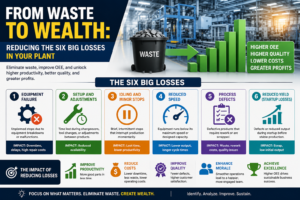
In today’s competitive manufacturing environment, operational efficiency is essential for maintaining profitability, product quality, and customer satisfaction. One of the most effective ways to improve manufacturing performance is by identifying and eliminating waste. A proven framework for achieving this goal is addressing the Six Big Losses, a concept widely used in Total Productive Maintenance (TPM) and Overall Equipment Effectiveness (OEE) improvement programs.
By reducing these common sources of inefficiency, manufacturers can transform wasted time, resources, and effort into measurable gains in productivity, profitability, and operational excellence.
What Are the Six Big Losses?
The Six Big Losses are six major categories of production losses that negatively impact equipment effectiveness and overall manufacturing performance. These losses directly affect the three key components of OEE: Availability, Performance, and Quality.
Understanding and reducing these losses allows organizations to maximize equipment utilization and achieve higher operational efficiency.
1. Equipment Failure (Breakdowns)
Equipment breakdowns are one of the most significant causes of production loss. Unexpected machine failures lead to unplanned downtime, missed production targets, and increased maintenance costs.
Common Causes
- Poor preventive maintenance
- Worn-out components
- Operator errors
- Lack of equipment monitoring
Improvement Strategies
- Implement preventive maintenance programs
- Use predictive maintenance technologies
- Train operators in equipment care
- Monitor machine health regularly
Reducing breakdowns improves equipment availability and production reliability.
2. Setup and Adjustment Losses
Setup and adjustment losses occur when machines are stopped or operating below optimal performance during product changeovers, tool replacements, or process adjustments.
Common Causes
- Lengthy changeover procedures
- Inefficient setup methods
- Lack of standardized processes
Improvement Strategies
- Apply SMED (Single-Minute Exchange of Die) techniques
- Standardize setup procedures
- Train operators for faster changeovers
- Prepare tools and materials in advance
Faster setups increase production flexibility and reduce downtime.
3. Idling and Minor Stops
These losses result from brief interruptions that temporarily stop production. Although individually small, they can significantly impact productivity over time.
Examples
- Material jams
- Sensor malfunctions
- Temporary blockages
- Operator interruptions
Improvement Strategies
- Improve equipment reliability
- Optimize process flow
- Conduct root cause analysis
- Implement continuous improvement programs
Minimizing minor stoppages helps maintain smooth and uninterrupted production.
4. Reduced Speed Losses
Reduced speed losses occur when equipment operates below its designed production rate. Machines may continue running, but not at peak efficiency.
Common Causes
- Aging equipment
- Poor maintenance
- Process inefficiencies
- Operator skill gaps
Improvement Strategies
- Maintain equipment regularly
- Upgrade outdated components
- Optimize production processes
- Provide operator training
Operating equipment at optimal speed improves throughput and productivity.
5. Process Defects and Quality Losses
Quality defects result in scrap, rework, wasted materials, and increased production costs. These losses directly impact customer satisfaction and profitability.
Common Causes
- Process variation
- Equipment issues
- Human errors
- Poor quality controls
Improvement Strategies
- Strengthen quality management systems
- Implement process monitoring
- Standardize operating procedures
- Conduct regular quality audits
Reducing defects improves product consistency and customer confidence.
6. Startup and Reduced Yield Losses
Startup losses occur during the initial stages of production when equipment has not yet reached stable operating conditions. During this phase, defective products and lower output levels are common.
Common Causes
- Equipment warm-up periods
- Process instability
- Incorrect settings
- Operator adjustments
Improvement Strategies
- Develop startup procedures
- Optimize machine settings
- Monitor startup performance
- Train operators effectively
Reducing startup losses increases production efficiency and minimizes waste.
Benefits of Reducing the Six Big Losses
Increased Productivity
Eliminating downtime and inefficiencies enables manufacturers to produce more products in less time.
Lower Operational Costs
Reduced breakdowns, defects, and waste lead to significant cost savings across production processes.
Improved Product Quality
Consistent processes and better equipment performance result in higher-quality products and fewer customer complaints.
Better Equipment Utilization
Organizations can maximize the value of their machinery and equipment investments.
Enhanced Employee Morale
Employees experience fewer disruptions, less frustration, and greater job satisfaction when production runs smoothly.
Stronger Competitive Advantage
Efficient manufacturing operations allow businesses to respond faster to customer demands and market changes.
Best Practices for Continuous Improvement
To successfully reduce the Six Big Losses, manufacturers should:
- Monitor OEE regularly
- Implement Total Productive Maintenance (TPM)
- Encourage employee involvement
- Use data-driven decision-making
- Conduct root cause analysis
- Invest in training and skill development
- Foster a culture of continuous improvement
Consistent improvement efforts create sustainable long-term results.
Conclusion
The Six Big Losses provide a powerful framework for identifying and eliminating waste within manufacturing operations. By focusing on equipment reliability, efficient setups, reduced downtime, optimal speed, improved quality, and stable startups, organizations can significantly enhance Overall Equipment Effectiveness (OEE).
Manufacturers that actively reduce these losses can transform operational waste into measurable value, resulting in higher productivity, lower costs, improved quality, and stronger business performance. In today’s competitive industrial landscape, reducing the Six Big Losses is not just an operational improvement strategy—it is a pathway to sustainable growth and manufacturing excellence.
Action Step
Start by measuring your current OEE and identifying which of the Six Big Losses has the greatest impact on your plant. Focus improvement efforts on that area first to achieve the fastest and most measurable results.
🚀 Ready to Transform Your Business?
From AI and Agentic AI to Cloud, Data, Automation, and Digital Transformation, KPSmart IT Solutions helps businesses turn technology opportunities into measurable business outcomes.
Have a challenge? Have an idea? Let’s talk.
👉 Explore KPSmart IT Solutions
KPSmart IT Solutions — Build Smart. Automate. Transform. Grow.
#KPSmartITSolutions #AI #ArtificialIntelligence #AgenticAI #DigitalTransformation #BusinessAutomation #EnterpriseAI #Innovation