
Back to: AjitPravas
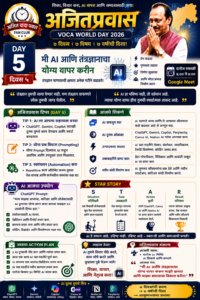
Day 5 – AI, Technology & Digital Leadership
Theme
Lead the AI Revolution
Learning Objectives
- AI literacy
- Digital transformation
- Productivity with AI
- Responsible AI
Modules
- AI Fundamentals
- Generative AI
- Prompt Engineering
- AI Agents
- Automation
- Digital Productivity
Frameworks
- AI Adoption Framework
- Digital Maturity Model
- Human + AI Collaboration
Tools
- ChatGPT
- Microsoft Copilot
- Gemini
- Claude
- Perplexity
- Power Automate
- n8n
Case Studies
- Microsoft
- NVIDIA
- OpenAI
Activity
Build an AI Assistant.
Deliverable
Personal AI Toolkit
Day 5 – AI, Technology & Digital Leadership
Lead the AI Revolution
“Artificial Intelligence will not replace humans. Humans who know how to use AI effectively will replace those who do not.”
We are living through one of the most significant technological revolutions since the invention of the internet. Artificial Intelligence (AI) is no longer a futuristic concept—it is reshaping industries, redefining careers, transforming governments, and influencing the way people learn, work, create, and make decisions.
From personalized healthcare and intelligent manufacturing to autonomous vehicles and digital assistants, AI is becoming the foundation of modern innovation. Organizations across every sector are integrating AI to improve productivity, automate routine work, enhance customer experiences, and unlock new business opportunities.
However, technology alone does not create value. The true competitive advantage lies in leaders who understand how to strategically adopt AI, collaborate with intelligent systems, and apply technology responsibly.
This session equips participants with the knowledge, tools, and frameworks required to become AI-ready professionals and digital leaders capable of driving innovation in an AI-powered world.
Why AI Leadership Matters
Artificial Intelligence is transforming every profession.
Today’s professionals are expected to:
-
Work alongside AI systems.
-
Automate repetitive tasks.
-
Make data-driven decisions.
-
Create intelligent products and services.
-
Improve organizational productivity.
-
Understand ethical implications of AI.
Organizations are increasingly hiring professionals who combine domain expertise with AI literacy.
The future belongs not only to AI specialists but also to professionals who know how to use AI effectively in their respective fields.
Learning Objectives
By the end of this session, participants will be able to:
-
Understand the fundamentals of Artificial Intelligence.
-
Differentiate between traditional AI and Generative AI.
-
Use AI tools to improve productivity.
-
Design effective prompts for AI systems.
-
Understand AI agents and intelligent automation.
-
Lead digital transformation initiatives.
-
Apply AI responsibly with awareness of ethics, privacy, and governance.
-
Build a personalized AI toolkit for work and lifelong learning.
Module 1: AI Fundamentals
What is Artificial Intelligence?
Artificial Intelligence refers to computer systems capable of performing tasks that typically require human intelligence.
These tasks include:
-
Learning
-
Reasoning
-
Problem-solving
-
Language understanding
-
Image recognition
-
Decision-making
-
Prediction
AI systems analyze data, identify patterns, and generate recommendations or actions based on learned knowledge.
Evolution of AI
Rule-Based Systems
AI initially relied on predefined rules and expert systems.
Example:
“If temperature exceeds 100°C, trigger an alarm.”
Machine Learning
Instead of explicit programming, machines learn patterns from data.
Applications include:
-
Fraud detection
-
Recommendation systems
-
Email spam filtering
Deep Learning
Inspired by neural networks, deep learning enables machines to process complex information such as speech, images, and videos.
Applications:
-
Medical imaging
-
Face recognition
-
Autonomous driving
Generative AI
The latest evolution of AI enables machines to generate original content, including:
-
Text
-
Images
-
Videos
-
Code
-
Music
-
Presentations
Examples include ChatGPT, Claude, Gemini, and image generation models.
AI in Everyday Life
Artificial Intelligence powers many familiar services:
-
Voice assistants
-
Online shopping recommendations
-
Digital maps
-
Language translation
-
Banking fraud detection
-
Healthcare diagnostics
-
Smart manufacturing
-
Personalized education
AI is becoming an invisible partner in everyday decision-making.
Module 2: Generative AI
The New Era of Content Creation
Generative AI creates new content rather than simply analyzing existing information.
It can generate:
-
Reports
-
Emails
-
Marketing campaigns
-
Software code
-
Research summaries
-
Images
-
Business strategies
-
Learning materials
How Generative AI Works
Generative AI is trained on vast amounts of data to recognize patterns in language, images, and other forms of information.
It predicts the most relevant output based on user instructions, known as prompts.
The quality of the output depends largely on the quality of the prompt.
Business Applications
Organizations use Generative AI for:
-
Customer support
-
Content creation
-
Software development
-
Sales enablement
-
HR recruitment
-
Data analysis
-
Product design
-
Knowledge management
Module 3: Prompt Engineering
Communicating Effectively with AI
Prompt Engineering is the skill of providing clear, structured instructions to AI systems in order to achieve accurate and useful responses.
Think of prompting as managing a highly capable digital colleague: the clearer your request, the better the outcome.
Characteristics of Effective Prompts
Good prompts include:
-
Context
-
Objective
-
Audience
-
Constraints
-
Desired format
-
Examples
Example
Weak Prompt:
“Write about AI.”
Improved Prompt:
“Write a 1,000-word blog for MBA students explaining how Artificial Intelligence is transforming supply chain management. Include real-world examples, benefits, challenges, and future trends.”
The second prompt gives the AI enough context to produce a more relevant and actionable response.
Prompt Framework
A practical structure for prompts is:
-
Role: Assign the AI a role (e.g., “Act as a business consultant”).
-
Task: State the objective clearly.
-
Context: Provide background information.
-
Constraints: Mention limits such as length, tone, or audience.
-
Output Format: Specify the expected structure (table, report, presentation, checklist, etc.).
Module 4: AI Agents
Beyond Chatbots
Traditional AI tools respond to individual requests.
AI Agents go further—they can:
-
Plan tasks.
-
Make decisions.
-
Use multiple tools.
-
Retrieve information.
-
Execute workflows.
-
Collaborate with other agents.
-
Learn from feedback.
AI agents are increasingly used in business automation and digital operations.
Examples of AI Agents
-
Customer Support Agent
-
HR Recruitment Assistant
-
Financial Analysis Agent
-
Sales Assistant
-
Healthcare Advisor
-
Legal Research Assistant
-
Coding Assistant
-
Personal Productivity Assistant
Agent Workflow
Goal
↓
Understand Request
↓
Plan
↓
Use Tools
↓
Execute Tasks
↓
Review Results
↓
Improve
Module 5: Automation
Work Smarter, Not Harder
Automation reduces repetitive manual work.
Instead of performing repetitive tasks every day, professionals can automate workflows and focus on strategic activities.
Automation Examples
-
Invoice processing
-
Email responses
-
Customer onboarding
-
Lead generation
-
Data synchronization
-
Report generation
-
Document approvals
-
Meeting scheduling
Benefits
-
Higher productivity.
-
Fewer errors.
-
Faster execution.
-
Lower operational costs.
-
Improved employee satisfaction.
Automation complements human expertise rather than replacing it.
Module 6: Digital Productivity
Amplifying Human Potential
Digital productivity combines AI, collaboration platforms, and cloud technologies to help professionals work more effectively.
Examples include:
-
Drafting reports with AI assistance.
-
Summarizing meetings.
-
Organizing research.
-
Managing projects.
-
Automating recurring tasks.
-
Creating presentations.
-
Analyzing large datasets.
The goal is to free time for strategic thinking, creativity, and innovation.
AI Leadership Frameworks
1. AI Adoption Framework
Successful AI implementation follows a structured approach:
Step 1 – Identify Opportunities
Determine where AI can create measurable value.
Step 2 – Assess Readiness
Evaluate data quality, infrastructure, governance, and workforce skills.
Step 3 – Pilot
Launch a small, focused AI project to validate benefits.
Step 4 – Scale
Expand successful initiatives across teams or departments.
Step 5 – Govern
Establish policies for security, privacy, ethics, and performance monitoring.
AI adoption is a continuous transformation rather than a one-time project.
2. Digital Maturity Model
Organizations progress through different stages of digital transformation:
Level 1 – Traditional
Mostly manual processes.
Level 2 – Digitized
Basic digital tools are introduced.
Level 3 – Connected
Departments and systems share information.
Level 4 – Intelligent
AI supports decision-making and automation.
Level 5 – Autonomous
AI continuously optimizes operations with minimal human intervention.
Leaders should understand their organization’s current maturity level before defining transformation strategies.
3. Human + AI Collaboration
AI is most effective when it augments human capabilities rather than replacing them.
Humans Contribute
-
Creativity
-
Empathy
-
Ethics
-
Leadership
-
Strategic judgment
-
Relationship building
AI Contributes
-
Speed
-
Scale
-
Pattern recognition
-
Data analysis
-
Automation
-
Content generation
The strongest outcomes emerge when humans and AI collaborate effectively.
AI Tools for Modern Professionals
ChatGPT
Ideal for:
-
Writing
-
Brainstorming
-
Research
-
Coding assistance
-
Business documentation
-
Learning support
Microsoft Copilot
Integrated into Microsoft 365 to assist with:
-
Word
-
Excel
-
PowerPoint
-
Outlook
-
Teams
It helps automate routine office tasks and enhance productivity.
Gemini
Google’s AI assistant supports:
-
Search
-
Writing
-
Workspace applications
-
Data analysis
-
Multimodal interactions
Claude
Designed for thoughtful conversations, document analysis, long-form writing, and knowledge work.
Perplexity
An AI-powered research assistant that provides answers with supporting sources, making it valuable for learning and fact-finding.
Power Automate
A low-code automation platform for building workflows across Microsoft and third-party applications.
Typical uses include:
-
Approval workflows
-
Notifications
-
Document routing
-
Business process automation
n8n
An open-source workflow automation platform that connects APIs, databases, cloud services, and AI models to create flexible automation solutions.
It is particularly useful for building AI-powered business processes and custom integrations.
Responsible AI
AI leadership also requires ethical responsibility.
Responsible AI includes:
-
Transparency
-
Fairness
-
Privacy protection
-
Security
-
Human oversight
-
Accountability
-
Compliance with regulations
Professionals should verify AI-generated outputs, protect sensitive information, and recognize the limitations of AI systems.
Case Studies
Microsoft – Driving AI Across the Enterprise
Microsoft has integrated AI throughout its ecosystem, from Microsoft 365 Copilot to Azure AI services and GitHub Copilot. Rather than treating AI as a standalone product, Microsoft positions it as a productivity partner embedded into everyday workflows. This strategy has enabled organizations to improve collaboration, automate routine tasks, and enhance decision-making while maintaining enterprise-grade security and governance.
Leadership Lesson: AI delivers the greatest value when it is seamlessly integrated into daily work and supported by a strong culture of innovation and responsible governance.
NVIDIA – Powering the AI Revolution
Originally known for graphics processing units (GPUs), NVIDIA recognized early that its hardware could accelerate machine learning and deep learning workloads. By investing heavily in AI research, developer ecosystems, and high-performance computing, the company became the foundational technology provider for modern AI applications.
Leadership Lesson: Long-term vision, sustained investment in innovation, and ecosystem building can position an organization at the center of an industry transformation.
OpenAI – Accelerating Human Productivity
OpenAI has demonstrated how large language models can support education, research, software development, creative work, and business operations. By making conversational AI accessible to individuals and organizations, it has encouraged widespread experimentation with AI-assisted workflows while emphasizing responsible deployment and continuous improvement.
Leadership Lesson: Breakthrough technologies create lasting impact when they are made accessible, practical, and continuously refined through user feedback.
Activity: Build Your Own AI Assistant
Participants will design an AI assistant tailored to a real-world personal or professional need.
Step 1 – Define the Use Case
Choose a practical objective, such as:
-
Study Assistant
-
Customer Support Assistant
-
HR Assistant
-
Financial Planning Assistant
-
Healthcare Information Assistant
-
Sales Assistant
-
Research Assistant
-
Content Creation Assistant
Step 2 – Identify the Target Users
Define who will use the assistant and what outcomes they expect.
Step 3 – Design the Workflow
Map the interaction:
User Request
↓
AI Understanding
↓
Knowledge Retrieval
↓
Reasoning
↓
Response Generation
↓
Feedback and Improvement
Step 4 – Select the Appropriate Tools
Determine which AI and automation platforms are needed, such as:
-
Conversational AI
-
Workflow automation
-
Knowledge repositories
-
Productivity applications
-
Collaboration platforms
Step 5 – Prototype and Test
Develop a basic version, test it with sample scenarios, gather feedback, and refine the assistant for accuracy, usability, and reliability.
Deliverable: Personal AI Toolkit
Each participant will prepare a personalized AI toolkit that supports learning, productivity, and professional growth.
The toolkit should include:
-
Personal AI Vision Statement
-
Current AI Skill Assessment
-
Preferred AI Tools and Their Use Cases
-
Prompt Library for Daily Tasks
-
Automation Opportunities
-
AI Learning Roadmap
-
Responsible AI Guidelines
-
Productivity Workflow Using AI
-
Monthly AI Experimentation Plan
-
Professional Development Goals
-
Metrics for Measuring AI Adoption
-
Continuous Improvement Strategy
Key Takeaways
By the end of Day 5, participants will:
-
Understand the evolution and practical applications of Artificial Intelligence.
-
Distinguish between traditional AI, machine learning, and Generative AI.
-
Design effective prompts that improve AI-assisted outcomes.
-
Understand how AI agents and workflow automation enhance business operations.
-
Apply frameworks for AI adoption and digital transformation.
-
Build productive partnerships between human expertise and AI capabilities.
-
Use leading AI tools to improve communication, research, analysis, content creation, and automation.
-
Recognize the importance of ethics, governance, privacy, and responsible AI practices.
-
Develop a practical Personal AI Toolkit that supports lifelong learning and professional excellence.
“The leaders of tomorrow will not be those who compete against Artificial Intelligence, but those who learn to lead with it. Digital leadership is the ability to combine human creativity, ethical judgment, and strategic vision with the speed, intelligence, and scalability of AI. Those who master this collaboration will shape the future rather than simply adapt to it.”