
Introduction
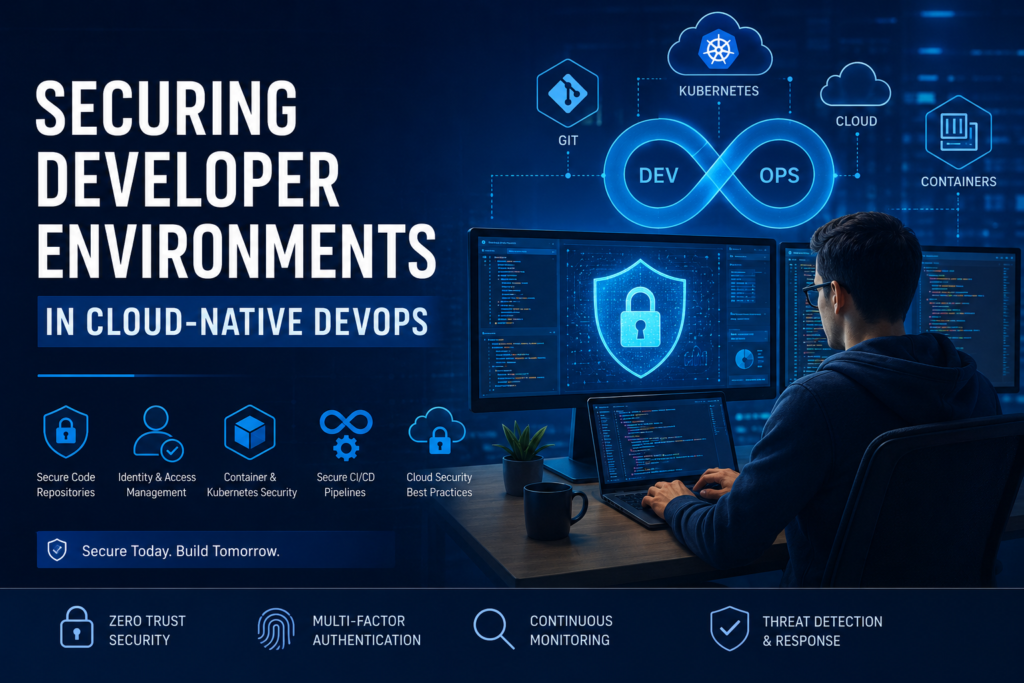
Securing Developer Environments in Cloud-Native DevOps has become a critical priority for organizations adopting modern software development practices. As development teams increasingly rely on cloud-native infrastructure, containers, Kubernetes, and automated CI/CD pipelines, developer environments have become attractive targets for cybercriminals.
However ,A single compromised developer workstation or insecure development environment can expose source code, credentials, APIs, and production systems. Therefore, organizations must implement strong security controls that protect developers without slowing innovation. Securing Developer Environments in Cloud-Native DevOps helps reduce security risks, improve compliance, and strengthen overall cyber resilience. Moreover Organizations can follow security recommendations published by CISA for secure software development.
Why Developer Environment Security Matters
Developer environments serve as the foundation of software development. Developers interact with source code repositories, cloud platforms, deployment pipelines, and production resources daily. Consequently, attackers frequently target these environments to gain unauthorized access to valuable systems.
Common risks include:
- Credential theft
- Malware infections
- Insecure code repositories
- Misconfigured cloud resources
- Supply chain attacks
- Unauthorized access
Furthermore, as remote and hybrid work models become more common, securing distributed developer environments has become increasingly important.
Key Security Challenges in Cloud-Native DevOps
Credential Exposure
Developers often work with API keys, access tokens, and cloud credentials. However, improperly stored credentials can become easy targets for attackers.
Organizations should:
- Use secret management tools
- Rotate credentials regularly
- Implement least-privilege access
- Monitor credential usage
Insecure Development Devices
Developer laptops and workstations often contain sensitive information. Therefore, endpoint security must be a top priority.
Best practices include:
- Device encryption
- Endpoint detection and response (EDR)
- Multi-factor authentication
- Regular patch management
Open-Source Dependency Risks
Modern applications rely heavily on open-source components. Although these tools accelerate development, they can introduce vulnerabilities if not managed properly.
To reduce risks:
- Scan dependencies regularly
- Monitor software bill of materials (SBOM)
- Update outdated packages
- Use trusted repositories
Misconfigured Cloud Resources
Cloud-native development environments often involve multiple cloud services and resources. Unfortunately, configuration errors remain one of the leading causes of security incidents.
Therefore, organizations should:
- Implement infrastructure-as-code security checks
- Use automated configuration validation
- Conduct regular security audits
Best Practices for Securing Developer Environments in Cloud-Native DevOps
Implement Zero Trust Security
As a result Zero Trust security assumes that no user or device should be trusted automatically.
As a result, organizations can:
- Reduce insider threats
- Strengthen access controls
- Improve visibility
- Limit unauthorized access
Zero Trust principles are becoming essential for Securing Developer Environments in Cloud-Native DevOps.
Enforce Multi-Factor Authentication
Multi-factor authentication provides an additional layer of protection against credential theft.
In addition, Benefits include:
- Reduced account compromise risks
- Improved identity verification
- Enhanced regulatory compliance
Moreover, MFA should be mandatory for all development tools and cloud services.
Secure Source Code Repositories
Source code repositories contain valuable intellectual property and sensitive information.
Meanwhile, To protect repositories:
- Use role-based access controls
- Enable branch protection rules
- Monitor repository activity
- Require code reviews
Consequently, organizations can significantly reduce unauthorized code modifications.
Adopt Secure Coding Practices
Secure coding helps prevent vulnerabilities from entering applications during development.
Developers should:
- Follow secure coding standards
- Perform code reviews
- Conduct static application security testing (SAST)
- Use dependency scanning tools
Furthermore, integrating security into development workflows supports long-term software quality.
Secure CI/CD Pipelines
CI/CD pipelines automate software delivery and deployment. However, compromised pipelines can expose entire production environments.
Moreover, Organizations should:
- Restrict pipeline access
- Scan code automatically
- Validate deployment configurations
- Monitor build environments
Therefore, securing CI/CD pipelines is a critical component of Securing Developer Environments in Cloud-Native DevOps.
The Role of DevSecOps
DevSecOps integrates security into every stage of the development lifecycle. Rather than treating security as a separate process, DevSecOps encourages collaboration between developers, operations teams, and security professionals.
Benefits include:
- Faster vulnerability detection
- Continuous compliance
- Reduced remediation costs
- Improved development efficiency
As organizations embrace DevSecOps practices, security becomes a shared responsibility across teams.
Emerging Trends in Developer Environment Security
AI-Powered Threat Detection
Artificial intelligence is helping organizations detect suspicious behavior and identify threats faster than traditional security tools.
Security as Code
Security policies can now be managed using code, allowing organizations to automate compliance and enforce consistent security controls.
Continuous Monitoring
Continuous monitoring provides real-time visibility into developer activities, system changes, and potential security risks.
Cloud-Native Security Platforms
Integrated security platforms offer centralized visibility across development environments, cloud infrastructure, and applications.
Benefits of Securing Developer Environments in Cloud-Native DevOps
Organizations that invest in developer environment security gain several advantages:
Improved Security Posture
Strong security controls reduce attack surfaces and minimize vulnerabilities.
Faster Incident Response
Enhanced visibility enables faster threat detection and remediation.
Better Compliance
Organizations can meet regulatory requirements more effectively through automated security controls.
Increased Developer Productivity
Secure and reliable environments allow developers to focus on innovation rather than security concerns.
Enhanced Customer Trust
Protecting development processes helps safeguard customer data and business operations.
Future Outlook
As cloud-native technologies continue evolving, developer environments will become even more critical to organizational security. Consequently, businesses must adopt proactive strategies that address emerging threats while supporting development agility.
However, Organizations that prioritize Securing Developer Environments in Cloud-Native DevOps today will be better prepared to manage future cybersecurity challenges and maintain secure software delivery pipelines.
Conclusion
Securing Developer Environments in Cloud-Native DevOps is essential for protecting modern software development workflows. From securing credentials and endpoints to implementing Zero Trust security and DevSecOps practices, organizations must address security throughout the entire development lifecycle.
Ultimately, businesses that invest in developer environment security will strengthen resilience, improve compliance, and reduce the likelihood of costly security incidents.
Frequently Asked Questions
Why is securing developer environments important?
Developer environments often contain source code, credentials, and access to critical systems, making them attractive targets for attackers.
What is Zero Trust security?
Zero Trust is a security model that continuously verifies users and devices before granting access to resources.
How does DevSecOps improve security?
DevSecOps integrates security throughout the software development lifecycle, enabling faster vulnerability detection and remediation.
What are the biggest threats to developer environments?
Additionally , Credential theft, malware, insecure dependencies, cloud misconfigurations, and supply chain attacks are among the most common risks.
How can organizations improve developer environment security?
Organizations should implement MFA, Zero Trust, secure coding practices, endpoint protection, and continuous monitoring.
🚀 Ready to Transform Your Business?
From AI and Agentic AI to Cloud, Data, Automation, and Digital Transformation, KPSmart IT Solutions helps businesses turn technology opportunities into measurable business outcomes.
Have a challenge? Have an idea? Let’s talk.
👉 Explore KPSmart IT Solutions
KPSmart IT Solutions — Build Smart. Automate. Transform. Grow.
#KPSmartITSolutions #AI #ArtificialIntelligence #AgenticAI #DigitalTransformation #BusinessAutomation #EnterpriseAI #Innovation